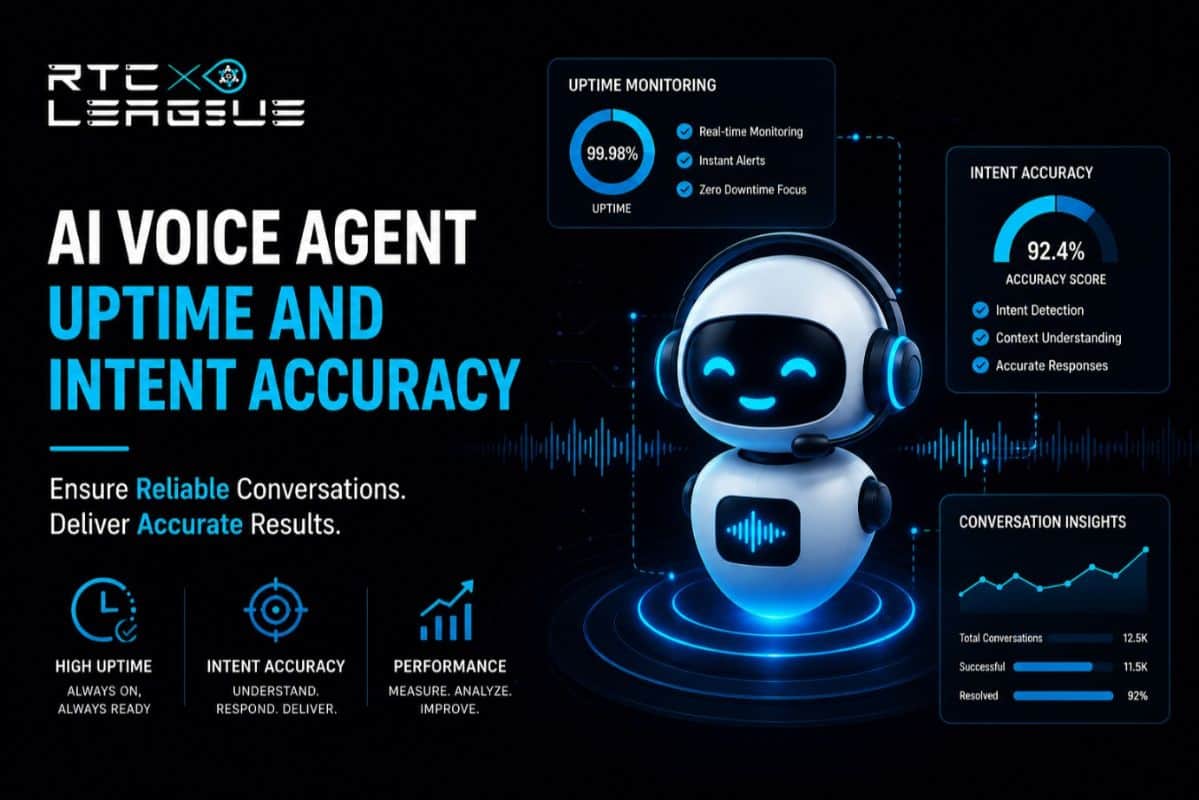

Deploying an AI voice agent is straightforward. Keeping it performing at the level your business depends on is a different problem entirely.
When a voice agent misunderstands a caller or drops offline during peak hours, the cost is not just a failed interaction. It is a broken customer experience, a support ticket, and in regulated industries, a compliance gap. Most teams treat monitoring as an afterthought until something goes wrong. This guide covers what you actually need to track, how to set it up, and where most monitoring setups fail before they catch the real issues.
Why AI Voice Agent Monitoring Is a Business-Critical Function
A voice agent operating at 97% uptime sounds reliable. But at 1,000 calls per day, that 3% gap means 30 failed calls. At 10,000 calls, it is 300.
Intent accuracy creates a compounding problem. An agent recognizing intent correctly 90% of the time seems acceptable until you realize 10% of callers either get misrouted, repeat themselves, or abandon the call. For enterprise deployments handling appointment scheduling, payment collections, or first-line customer support, that number has a direct dollar value attached to it.
The monitoring layer sits between your deployment and your SLA. Without it, you are flying blind.

Core Metrics to Track for AI Voice Agent Performance
Uptime and Availability SLA
Start with infrastructure-level availability. Your voice agent stack typically spans a telephony layer (SIP trunking or WebRTC), an NLU engine, a TTS/STT provider, and your backend logic. Each component can fail independently.
Track availability at two levels:
Endpoint availability — Is the agent reachable and answering calls?
Component availability — Are the ASR, NLU, and TTS layers all responding within acceptable latency windows?
A common mistake is monitoring only the telephony endpoint. If your NLU layer times out but calls still connect, the agent will accept calls it cannot process, which is worse than an outage.
Target SLA benchmarks for production deployments: 99.9% endpoint uptime with NLU response under 300ms per turn.
Intent Recognition Accuracy Rate
Intent accuracy is the percentage of utterances where the agent correctly identifies what the caller is trying to do. It is not the same as transcription accuracy.
You need to track this per intent category, not just as a global average. An agent that handles billing queries at 98% accuracy but misclassifies 40% of escalation requests is a liability, not an asset.
Minimum viable tracking setup:
Segment this by call type, time of day, and caller language/accent variation. High variance in accuracy across segments is usually a training data problem or a noise floor issue in the audio pipeline.
First-Call Resolution Rate and Fallback Rate
First-call resolution measures how often the agent fully handles a request without human handoff. The fallback rate measures how often the agent cannot match an intent and defaults to a clarification prompt or transfers to a human.
A fallback rate above 15% in a mature deployment is a signal. Either the intent coverage in your NLU model is incomplete, or callers are asking questions your agent was not designed to handle and no one caught it during QA.
Response Latency
End-to-end latency per conversational turn affects perceived quality more than any other single metric. Callers tolerate pauses of up to 800ms before the interaction starts to feel broken. Over 1.2 seconds, abandonment probability increases sharply.
Track latency at the component level: ASR processing time, NLU inference time, backend lookup time, and TTS synthesis time. When latency spikes, you need to know which layer caused it.
Setting Up an AI Voice Agent Monitoring Stack
Infrastructure Layer: Health Checks and Synthetic Calls
Set up synthetic monitoring that places test calls at regular intervals, 5 to 10 minutes in production, and validates that the agent responds correctly to a defined script. This catches outages faster than passive alerting.
For WebRTC based deployments, add WebRTC stats monitoring for packet loss and jitter. Packet loss above 1% degrades STT accuracy measurably. Above 3%, the call quality breaks down enough to affect intent classification regardless of how good your NLU model is.
Tools that work well at this layer: Prometheus with Grafana for infrastructure metrics, combined with a call simulation script hitting your SIP endpoint or WebRTC signaling server directly.
NLU Layer: Shadow Logging and Confidence Score Tracking
Every utterance processed by your NLU engine returns a confidence score alongside the predicted intent. Log these. Low-confidence matches, typically below 0.70 on a normalized scale, should trigger a review queue rather than silent execution.
Set up shadow logging to capture a sample of live transcriptions alongside intent classifications without affecting call flow. Run weekly accuracy audits against this dataset. Three to five hours per week spent reviewing low-confidence logs will surface more real-world coverage gaps than any synthetic test suite.
Conversation Analytics: Exit Point and Drop-off Tracking
Map where conversations end. If 30% of calls drop at the same dialog node, that node has a problem. Either the prompt is confusing, the intent coverage for expected responses is missing, or the expected caller behavior does not match what was modeled during training.
Build a funnel view across your call flows. Most platforms expose conversation logs via webhook or API. Pipe this into a data warehouse or a lightweight analytics setup and visualize completion rates per call path.
Real-Time Alerting Thresholds to Configure
Do not wait for a human to notice something is wrong. Set hard alerting thresholds on:
Uptime below 99.5% in any 1-hour window
NLU inference latency above 400ms for more than 5% of calls in a 15-minute window
Intent accuracy below 85% for any single intent category measured over a rolling 500-call window
Fallback rate above 20% in any 30-minute window
Call abandonment rate increase of more than 10% over the previous day's baseline
Route alerts to your on-call channel immediately. Voice agent failures are customer-facing and need sub-15-minute response times.
Common Failure Patterns and Early Warning Signs
Accuracy drift is the most common long-term failure mode. It happens gradually as caller language evolves, new products get launched, or seasonal phrasing changes. Your intent model does not retrain itself. Schedule quarterly retraining cycles minimum, or set up automated triggers when accuracy drops below a rolling threshold.
Latency cascades happen when a single slow component holds up the full response chain. A backend database query timing out will stall TTS synthesis even if ASR and NLU are healthy. Build timeouts at every integration boundary with graceful fallback behavior.
Transcription degradation during high-traffic periods is common when ASR infrastructure is not auto-scaled. CPU contention during peak load raises word error rates, which directly tanks intent classification accuracy downstream.

Building a Continuous Improvement Loop
Monitoring is not the end goal. The data it generates feeds your improvement process.
Every week, pull the bottom 10% of calls ranked by intent confidence score. Review them manually or through a human review pipeline. Identify new utterance patterns, add them to your training corpus, retrain, test, and redeploy. The teams running voice agents at the highest accuracy levels are the ones running this loop on a fixed schedule, not reactively.
RTC LEAGUE monitoring infrastructure turns your production environment into a continuous learning dataset. That is where the compounding returns come from.


-(1).jpg)
.jpg)