.png&w=96&q=75)
Cash on Delivery (COD) remains one of the most widely used payment methods in e-commerce. But operationally, it introduces a serious challenge: order uncertainty. Not every placed order turns into a successful delivery.
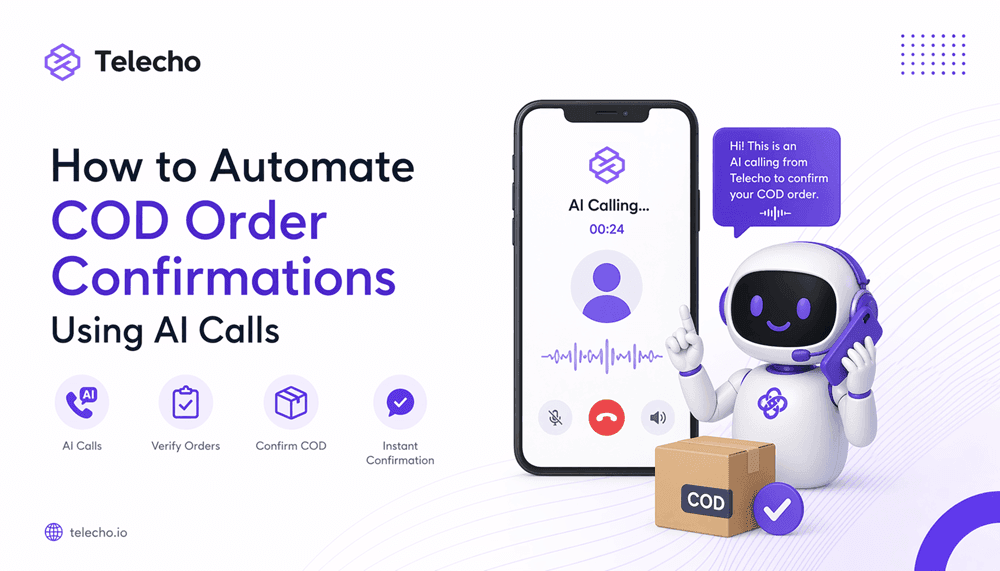
To manage this, businesses rely on confirmation calls. But manual calling systems were never designed for scale. AI voice call automation changes this completely, turning a reactive, manual process into a real-time, intelligent system.
The Problem: Order Confirmation Is a Bottleneck
Order confirmation sits between order placement and fulfillment, but it’s often the weakest link in the workflow.
Manual processes create delays. By the time a call is made, the customer may no longer be available or interested.
At scale, teams prioritize speed over quality, leading to rushed conversations and inaccurate confirmations.
At the same time, operational costs increase with every additional agent.
The result is a system that:
Slows down order processing
Increases unverified shipments
Adds unnecessary operational overhead
This isn’t just a workflow issue, it directly impacts profitability.
The Solution: Automating COD Confirmations with TelEcho
Modern businesses are moving away from agent-dependent workflows toward automation.
AI voice agents replace repetitive confirmation calls with instant, structured, and scalable interactions.
Instead of waiting in a queue, every order is processed immediately.
Instead of inconsistent communication, every call follows a defined, optimized flow.
Platforms like TelEcho enable businesses to build these systems without managing infrastructure or large teams.
How AI Automates COD Order Confirmations
At its core, AI call automation is not just about placing calls, it’s about orchestrating decisions in real time.
Here’s how the system works in practice:
1. Trigger-Based Execution
Every new order automatically enters the confirmation pipeline.
2. Instant Outreach
The AI agent initiates a call within seconds, reducing the delay between intent and verification.
3. Context-Aware Conversation
The system references order details and guides the conversation dynamically, rather than following a rigid script.
4. Decision Capture
Customer responses are classified into clear outcomes: confirmed, cancelled, or modified.
5. System Synchronization
All outcomes are instantly reflected in your backend systems, eliminating manual updates.
6. Intelligent Retry Strategy
Unanswered calls are retried using timing patterns that maximize pickup probability.
This creates a closed-loop system where no order is left unverified.
AI Voice Agent for Order Confirmations
An AI voice agent functions as a specialized layer within your operations, focused entirely on customer verification.
It is designed for:
High-frequency, repetitive workflows
Structured conversations with clear outcomes
Real-time decision capture
Unlike traditional automation tools, these agents don’t just execute commands, they interpret and respond.
This makes them significantly more effective for customer-facing tasks.
Select the Right Voice for Maximum Engagement
Voice design is not a cosmetic feature, it directly affects performance.
Customers are more likely to respond to voices that sound:
Natural and conversational
Clear and easy to understand
Contextually appropriate
Advanced AI systems allow businesses to configure voice parameters such as tone, pacing, and language.
Optimizing voice experience can improve both engagement rates and confirmation accuracy.
Built for Scale: Reliable, Consistent, Always On
Order confirmation is a volume-driven process. Any solution must handle spikes without degradation.
AI systems are inherently designed for this environment.
They operate with:
No dependency on human availability
No drop in performance during peak hours
No variation in communication quality
This ensures that every order, regardless of volume, is processed with the same level of efficiency.
Key Capabilities That Define an Effective System
Not all AI call solutions deliver the same results. Performance depends on specific capabilities.
An effective system should include real-time language understanding to handle natural conversations.
It should integrate seamlessly with order management systems to avoid operational friction.
Retry logic must be intelligent, not random, to maximize answer rates.
Analytics should provide visibility into call outcomes, success rates, and failure patterns.
These elements determine whether the system simply automates calls, or actually improves business outcomes.
AI Voice Agents vs Call Centers: A Structural Advantage
Dimension | AI Voice Agents | Traditional Call Centers |
Cost model | Scales efficiently | Increases with headcount |
Throughput | Parallel and instant | Sequential and limited |
Availability | Continuous | Time-bound |
Consistency | Standardized | Agent-dependent |
Speed to action | Immediate | Delayed |
For repetitive, high-volume tasks like COD confirmations, AI is faster, cheaper, and more reliable.
Implementation: What Businesses Often Get Wrong
Adopting AI call automation is not just about plugging in a tool.
Common mistakes include:
Overcomplicating call scripts
Ignoring timing optimization
Failing to integrate backend systems
Not monitoring performance metrics
The most effective implementations start simple, then evolve based on real interaction data.
Conclusion
COD order confirmation is a critical step, but manual processes make it inefficient and costly.
AI voice call automation transforms this workflow into a fast, consistent, and scalable system.
By automating confirmations, businesses can reduce uncertainty, improve delivery success, and operate more efficiently.
Solutions like TelEcho make it possible to deploy this capability without complexity, turning order verification into a reliable, automated process.
.png&w=3840&q=75)

-(1).jpg)
.jpg)