.png&w=96&q=75)
AI voice platforms have moved past the stage where they were a novelty. In 2026, they are handling millions of customer conversations daily across industries, from telecom to healthcare to financial services.
The challenge is no longer whether to use one. It's knowing which platform actually fits your use case and what to look for before you sign a contract.
This guide breaks down what the best AI voice platforms do, how inbound and outbound requirements differ, and what makes one platform a better fit than another for your team.

What an AI Voice Platform Actually Does
An AI voice platform is software that enables businesses to deploy voice-based AI agents that can handle phone calls, respond to customer queries, qualify leads, route issues, and follow up with prospects, without a human on the line.
The best ones combine several technologies working together:
Component | What It Does |
Speech-to-Text (STT) | Converts caller speech into text for the AI to process |
Natural Language Understanding (NLU) | Interprets what the caller means, not just what they said |
Text-to-Speech (TTS) | Generates a natural-sounding spoken response |
Dialogue Management | Controls conversation flow and context retention |
CRM and Telephony Integration | Connects call data to your existing business systems |
When these components work together without noticeable delay, the result is a conversation that feels close to human. When any of them lag, the experience breaks down fast.
Inbound Support vs Outbound Sales: Why the Requirements Differ
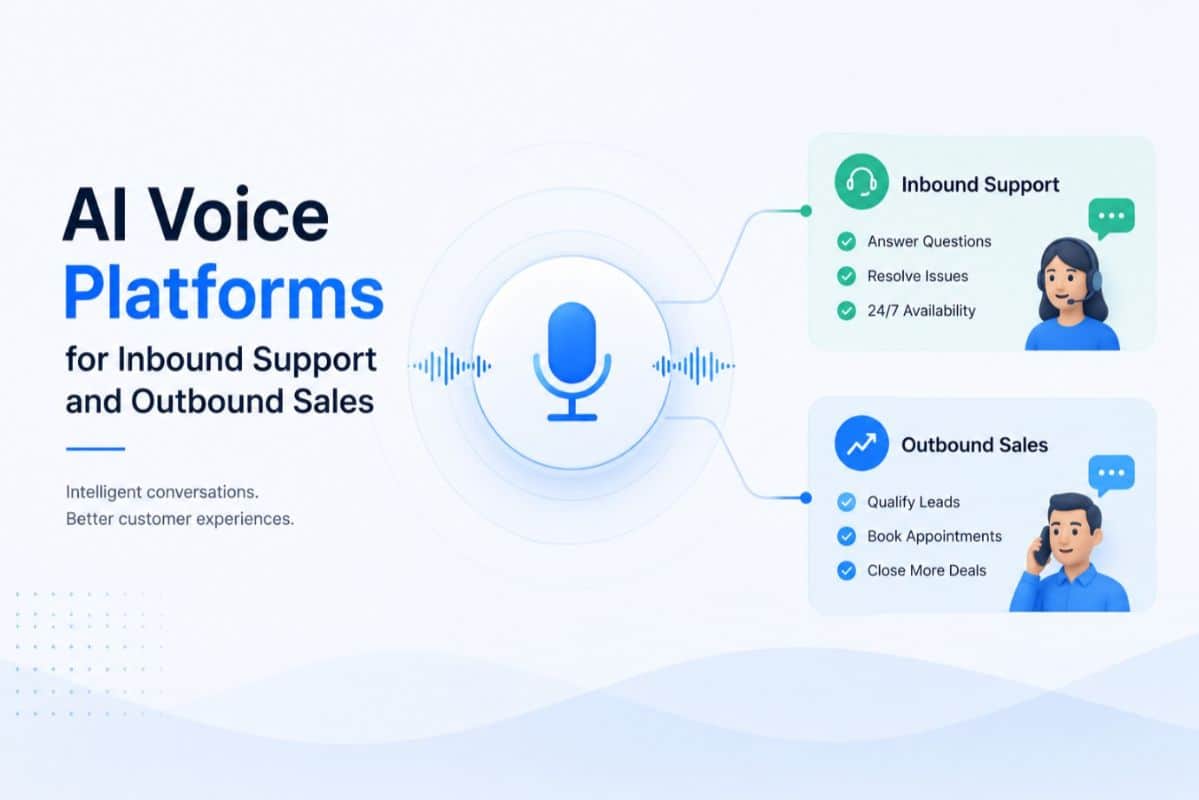
Before evaluating any platform, you need to be clear on whether your primary need is inbound, outbound, or both. The feature priorities are meaningfully different.

Inbound Support Priorities
Inbound callers are usually existing customers with a problem. They want a fast, accurate resolution. The platform needs to understand a wide range of intents, handle frustration without escalating it, and know when to transfer to a human gracefully.
Key requirements for inbound:
High intent recognition accuracy (a caller saying "my internet is out" needs to route differently from "I want to upgrade my plan")
Smooth escalation to live agents with full context handed off
24/7 availability without hold times
Integration with ticketing and CRM platforms
Support for complex multi-turn conversations
Outbound Sales Priorities
Outbound callers are reaching prospects who did not ask to be called. The first five seconds of the call determine whether they stay on the line. The AI needs to sound natural, get to the point, and handle objections without sounding like a bot reading a script.
Key requirements for outbound:
Natural, low-latency voice quality (delays above 300ms kill outbound conversion)
Dynamic script handling that responds to what the prospect actually says
A/B testing capability across call scripts
Compliance with calling regulations (TCPA, GDPR)
Clear handoff to a human for high-intent prospects
What to Look for in an AI Voice Platform
1. Latency
Latency is the time between when a caller finishes speaking and when the AI starts responding. In a normal human conversation, this gap is under 200ms. Most AI systems introduce 300ms to 700ms of delay, which is noticeable and often described by callers as "the robot thinking."
Platforms built on WebRTC and optimized real-time infrastructure, like those built by RTC LEAGUE, consistently deliver lower latency than platforms relying on traditional telephony stacks. This is one of the clearest differentiators between a demo-quality platform and one that holds up in production.
2. Intent Recognition Accuracy
Intent recognition is how well the AI understands what the caller means. This is different from transcription accuracy. A system can perfectly transcribe "I need to cancel my subscription" and still route the call to billing instead of cancellations if the intent mapping is poor.
Look for platforms that provide per-intent accuracy metrics, not just overall accuracy averages. An AI performing at 95% average accuracy but mishandling 40% of escalation intents is a problem.
3. Voice Quality
TTS voice quality has improved significantly, but the gap between natural-sounding and robotic is still large across platforms. The best AI voice platforms offer multiple voice options, support for regional accents, and prosody control so the AI pauses and stresses words in a way that matches normal speech patterns.
4. Scalability
A platform that handles 100 concurrent calls in testing needs to handle 10,000 during a campaign launch. Ask vendors specifically how the platform scales, where the infrastructure is hosted, and what their uptime SLA looks like during peak periods.
5. Integration Depth
An AI voice platform that doesn't connect to your CRM, ticketing system, or dialer is a silo. The best platforms offer native integrations with Salesforce, HubSpot, Zendesk, and major telephony providers, plus webhook and API access for custom connections.
Platform Categories Worth Evaluating in 2026
Enterprise Contact Center AI Platforms
These platforms are designed for large-scale deployments with complex workflows. They offer deep CRM integration, compliance tooling, and enterprise-grade uptime SLAs. They are typically priced for large teams and require dedicated IT involvement for implementation.
Best for: Established contact centers handling 50,000 or more calls per month that need a replacement for legacy IVR systems.
Mid-Market Conversational AI Platforms
These bridge the gap between full enterprise deployments and lightweight tools. They offer solid intent handling, pre-built connectors, and more flexibility in deployment without the six-figure implementation cost.
Best for: Growing businesses running outbound campaigns or handling inbound support at scale who cannot justify enterprise pricing yet.
Infrastructure-Level Voice AI Providers
These are companies building the real-time communication infrastructure that voice AI runs on. Rather than buying a packaged platform, you get the WebRTC infrastructure, SIP connectivity, and voice AI components to build exactly what your use case requires.
RTC LEAGUE sits in this category. The benefit is control. You're not locked into a platform's feature roadmap or pricing model. You deploy voice AI the way your business actually operates, not the way a SaaS vendor's template assumes it does.
Best for: Companies with technical teams that need specific call handling behavior, custom integrations, or multi-region low-latency deployments that packaged platforms cannot accommodate.
Lightweight Plug-and-Play AI Voice Bots
These tools prioritize fast deployment. They offer pre-built conversation templates for common use cases like appointment reminders, lead qualification, and basic FAQ handling. Setup is measured in hours, not months.
Best for: Small businesses or early-stage teams validating whether AI voice works for their customer base before committing to a larger build.

How to Compare Platforms Without Getting Misled
Most platforms look strong in a demo. The demo environment uses clean audio, a cooperative simulated caller, and carefully selected use cases. Here's what to test outside of the demo:
Test with real audio conditions. Run calls over mobile connections, from noisy environments, and with callers who speak quickly or with regional accents.
Test edge cases in the conversation. Ask a question the AI wasn't trained for. Interrupt mid-sentence. Pause unexpectedly. How the platform handles unexpected input tells you far more than how it handles a scripted exchange.
Ask for production metrics, not demo metrics. Request average intent accuracy, call drop rate, and latency data from a live deployment, not a controlled test environment.
Understand the escalation path. When the AI cannot handle something, how does it transfer? Does it pass the full transcript and context to the human agent, or does the caller have to start over?
The Bottom Line
The best AI voice platform for your business is the one that fits your call volume, your technical capacity, your latency requirements, and your integration environment. A platform that works well for a 200-seat contact center may be overkill for a 10-person sales team, and a lightweight chatbot-style tool will fall apart under real contact center load.
Start with your actual use case, test under real conditions, and prioritize latency and intent accuracy above all other features. Everything else is a nice-to-have.
.png&w=2048&q=75)

-(1).jpg)
.jpg)