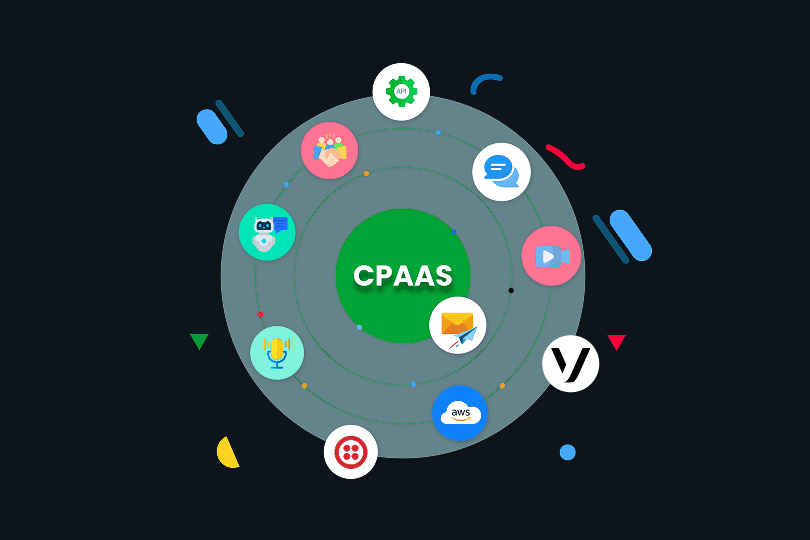

If you have spent time evaluating CPaaS providers, you have probably landed on the same shortlist. Twilio is almost always first. Vonage comes up next. AWS Connect gets mentioned if your stack is AWS-native. Bandwidth or Telnyx depending on who made the recommendation.
You read the documentation. You compared pricing pages. You built a proof of concept. And then you started asking the questions that the comparison blogs do not really answer.
What happens to our per-minute costs at 10 million minutes monthly? How much actual control do we have over media routing? What does support look like when something breaks in production on a Friday night? And if we ever need to move off this platform, what does that migration cost us?
This post is for teams who are past the surface-level comparison and want to understand what these platforms are actually built for, and where they start to show their limits.
What CPaaS Actually Means in 2026
Communications Platform as a Service is a cloud-based model that lets developers embed voice, video, SMS, and messaging capabilities into applications through APIs, without building the underlying telecom infrastructure themselves.
The category was built around a simple premise: don't build a telecom stack, call an API. For the use cases that existed when the major CPaaS providers scaled up, that was exactly the right answer. Send an SMS, trigger a call, receive a webhook. Simple, fast, effective.
The problem is that use cases have changed significantly. AI voice agents, real-time transcription pipelines, sub-100ms latency requirements, custom media processing, SIP trunking with on-premise PBX systems, WebRTC applications with fine-grained codec control — most of these push against the boundaries that the major CPaaS platforms were originally designed to handle.
So here is what each of the main CPaaS providers actually offers, and where the ceilings are.

Twilio
Twilio is the default starting point for most developers entering this space, and with good reason. The documentation is thorough. The API design is clean. The ecosystem, integrations, community resources, third-party tooling is the strongest of any CPaaS provider in the market.
For SMS, basic programmable voice, two-factor authentication, and simple communication workflows, Twilio is genuinely hard to beat on developer experience and time-to-first-working-prototype.
The complications show up at scale and at the edges of what the platform was designed to expose.
Pricing at volume. Twilio's model is consumption-based, which is efficient when you are small. When you are handling millions of voice minutes monthly, per-minute pricing includes a markup layer that sits between you and carrier rates. Teams who build serious voice products on Twilio regularly find, after 12 to 18 months, that a substantial portion of their infrastructure spend is going to that markup — costs they cannot optimize because they do not own the routing layer.
Note: Twilio has also announced the sunset of its Programmable Video API in 2026, which is a meaningful signal for teams currently relying on it for video use cases.
Media control. Twilio's media streaming APIs and TwiML give you significant flexibility for a CPaaS. But you are still working within their abstraction. If your product requires low-level WebRTC access, custom codec handling, real-time audio processing pipelines, or integration with an AI voice agent framework, you are pushing against the edges of what Twilio was designed to expose.
Best for: Teams building standard programmable voice and messaging workflows who prioritize fast time-to-market and developer experience over cost optimization at production scale.
Vonage
Vonage has gone through enough ownership changes that understanding what it actually is in 2026 requires some context. Post-Ericsson acquisition, it is positioned as an enterprise communications platform with emphasis on unified communications, contact center integrations, and network API capabilities.
The Video API built on the OpenTok platform Vonage acquired from TokBox, is genuinely capable and worth evaluating for video use cases. SIP connectivity is solid. Enterprise relationships are real.
The honest concern with Vonage in 2026 is product direction. When a developer-focused platform gets absorbed into a large telecom organization, roadmap clarity tends to suffer. Features that developers care about compete with enterprise sales priorities. What was once a nimble, API-first platform begins moving at the pace of a telecom company's procurement cycle.
That strategic uncertainty is a legitimate risk when you are building a long-term product on top of a CPaaS provider. Telecom consolidation in the CPaaS space — Ericsson-Vonage being the most visible example — has not generally produced better developer platforms.
Best for: Enterprises with existing Vonage or Ericsson relationships, or teams with strong video API requirements who do not need cutting-edge WebRTC control.
AWS Connect
AWS Connect is a contact center platform. That distinction is worth stating plainly, because it matters.
If you are building a customer service platform or a call center product, Connect deserves serious evaluation. The integration with the broader AWS ecosystem, Lambda, Lex, Kinesis, S3, Bedrock is a genuine competitive advantage. The pay-per-use pricing model can be economical at contact center scale.
If you are building a real-time communication product that is not a contact center, Connect is not the right tool. The abstraction level is high. Media control is limited. The WebRTC layer is largely opaque. And the platform is optimized for the workflows of a contact center operator, not a developer building custom real-time communication infrastructure.
The teams that run into the most friction with AWS Connect are typically those who chose it primarily because they were already on AWS, a reasonable starting assumption that stops holding up once the product requirements diverge from what Connect was built to solve.
Best for: Contact center deployments where deep AWS ecosystem integration is a strategic requirement.
The Pattern Across All of Them
Here is what most CPaaS comparison posts miss: every major CPaaS provider makes the same fundamental trade-off.
They abstract away infrastructure complexity to make the first portion of your build fast. That same abstraction eventually becomes the ceiling when you need control, cost structure, or performance that the platform was not designed to deliver.
This is not a criticism of how these platforms were built. Abstraction layers are how software infrastructure works. The relevant question is whether the ceiling they set is above or below where your product needs to go.
For a growing segment of teams — those building AI voice agents, WebRTC-native communication products, high-volume voice operations where per-minute costs are material, or real-time infrastructure for other developers — the ceiling of major CPaaS providers is genuinely below where they need to operate.

What the Alternative Actually Looks Like
The alternative to major CPaaS providers is not building everything from scratch. That carries its own costs and timelines that most teams cannot absorb.
The alternative is infrastructure built on open standards — SIP, WebRTC, RTP — with real control over the media layer and without the abstraction tax that comes with consumer-grade CPaaS platforms.
RTC League operates in this space. We build and manage real-time communication infrastructure for teams who need more than a CPaaS API can deliver: LiveKit based WebRTC deployments, SIP trunking with custom routing logic, AI voice pipeline integration, and low-latency media handling that falls outside what standard CPaaS providers support.
The honest framing is not "RTC League vs. Twilio." It is control and performance vs. speed of initial setup. If fast initial setup is what your team needs right now, use Twilio. If you are past that point and the platform is becoming the constraint on what you can build, that is when the conversation about infrastructure is worth having.
How to Choose the Right CPaaS Provider
A few questions that cut through the comparison noise:
What are your costs at volume? Model out per-minute pricing at your projected scale before committing to a consumption-based model. The numbers look different at 500,000 minutes monthly than they do at 5,000.
How much media control do you actually need? If your product requires real-time audio processing, custom codec support, or low-level WebRTC access, verify which platforms expose that before you build a year of product on one that does not.
What is your on-call reality? Some platforms give more control but require more operational ownership. Others abstract that away at a cost. Neither is wrong, but be honest about what your team can realistically maintain.
How much vendor lock-in are you accepting? Proprietary APIs, vendor-specific SDKs, and non-standard signaling protocols all create switching costs. Open standards do not. The difference matters when you need to migrate or negotiate pricing leverage.
Comparing CPaaS Providers at a Glance
Capability | Twilio | Vonage | AWS Connect | RTC League |
Developer experience | Excellent | Good | Moderate | Engineering-direct |
Voice at scale cost | High per-minute | Moderate | Per-use (contact center) | Infrastructure-based |
Media control | Limited | Moderate | Low | Full |
WebRTC support | Partial (Video API sunset 2026) | Moderate (OpenTok) | Minimal | Full (LiveKit) |
AI voice agent support | Via third-party | Limited | Via AWS Lex | Native integration |
SIP trunking | Yes | Yes | Yes | Yes, custom routing |
Vendor lock-in risk | High | Medium-High | High | Low (open standards) |
Best for | Programmable SMS/voice | Enterprise UC | Contact centers | Custom real-time infrastructure |


-(1).jpg)
.jpg)