.png&w=96&q=75)
customer support call, or a real-time video app recently, there's a decent chance LiveKit's infrastructure was running underneath it.
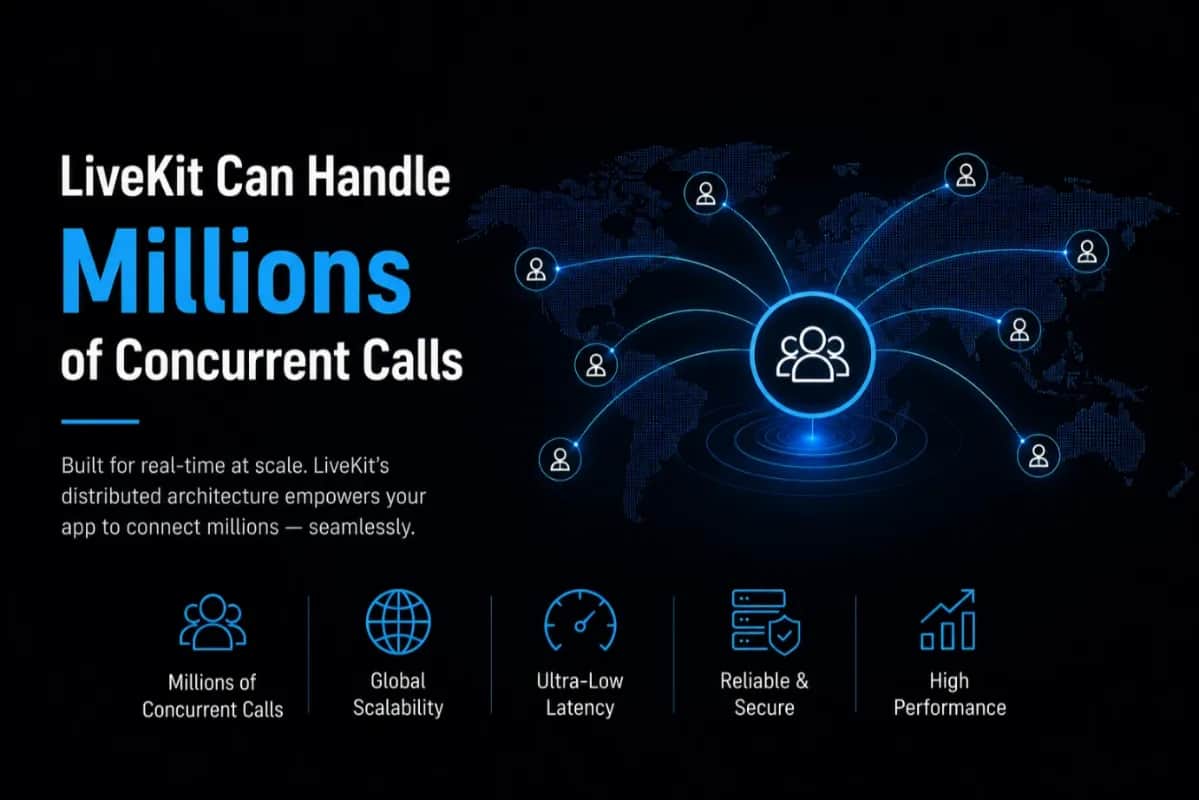
What makes LiveKit interesting isn't just that it works. It's that it can scale to handle millions of calls happening at the same time without falling over. For anyone building voice AI products, this matters more than most people realize.
What LiveKit Actually Is
LiveKit is an open-source platform built for real-time audio, video, and data. Think of it as the plumbing that connects two people, or a person and an AI agent, in a live conversation with minimal delay.
It's built on WebRTC, the same underlying technology behind Zoom, Google Meet, and most modern video calling apps. But LiveKit takes that technology and makes it easier to build on, scale, and customize for specific use cases like AI voice agents.
Why "Millions of Concurrent Calls" Is a Big Deal
Here's the simple version. Handling one phone call is easy. Handling a hundred is manageable. Handling a million calls happening at the exact same second, each one needing low delay and clear audio, is a completely different engineering problem.

The Scale Comparison
Scenario | Difficulty Level | Common Failure Point |
1 call | Trivial | None |
1,000 concurrent calls | Moderate | Server overload |
100,000 concurrent calls | High | Network routing, latency |
1,000,000+ concurrent calls | Very High | Global infrastructure, failover |
Most telephony systems hit a wall somewhere in the middle. LiveKit's architecture is designed specifically to avoid that wall.
How LiveKit Pulls This Off
1. It Runs on Distributed Servers, Not One Big Server
Instead of routing every call through a single central server, LiveKit distributes the load across many servers placed in different regions. A call from a user in Karachi doesn't need to travel to a server in the US and back. It connects to infrastructure closer to home.
This matters for two reasons: it reduces delay (latency), and it means no single server becomes a bottleneck.
2. It's Built on WebRTC, Designed for Real-Time From the Ground Up
Web RTC was built specifically for live audio and video, unlike older telephony protocols that were adapted for the internet later. This means LiveKit isn't fighting against its foundation to deliver low-latency calls. It's built for exactly this.
3. SIP Integration Connects It to the Regular Phone Network
This is the part that makes LiveKit useful for businesses, not just app-to-app calls. Through SIP (Session Initiation Protocol), LiveKit can connect to regular phone numbers. That means an AI voice agent built on LiveKit can actually answer a customer's phone call, not just a web-based chat.
4. Horizontal Scaling
When demand goes up, LiveKit doesn't need a bigger server. It adds more servers. This is called horizontal scaling, and it's the same principle that lets companies like Netflix and YouTube serve millions of users without their systems collapsing during peak hours.
Why This Matters for AI Voice Agents
AI voice agents need three things to work well: low latency (so the conversation feels natural), reliability (so calls don't drop), and scale (so the system works whether 10 people or 10,000 people call at once).
LiveKit's telephony infrastructure checks all three boxes. That's why it's become a popular foundation for companies building AI voice agents, especially ones handling customer support, appointment booking, or sales calls at high volume.
What This Looks Like in Practice
Business Need | How LiveKit Telephony Helps |
Customer support hotline | Handles call spikes during peak hours without delays |
AI sales calls at scale | Supports thousands of simultaneous outbound calls |
Appointment booking systems | Low latency means natural-feeling conversations |
Multi-region businesses | Routes calls through the nearest server location |
The Bottom Line
LiveKit didn't become popular because of marketing. It became popular because it solves a hard problem well: real-time communication that actually holds up under real-world load.
For businesses building or buying AI voice agent technology, infrastructure choices like this aren't just technical details. They directly affect call quality, reliability, and whether the system can grow with the business instead of breaking under its own success.
At RTC LEAGUE, this kind of infrastructure is exactly what powers reliable, real-time voice AI systems, built to handle real call volume, not just demo conditions.
.png&w=2048&q=75)

-(1).jpg)
.jpg)