
Most businesses shopping for SIP termination providers start by comparing per-minute rates. That is a reasonable instinct and also an incomplete one. The rate sheet is only one variable in a decision that will directly affect call quality, compliance exposure, scale capacity, and what your AI calling infrastructure can actually do in production.
This guide covers what SIP termination is, how it differs from SIP origination, what separates a reliable provider from an unreliable one, and what the evaluation actually looks like when you do it properly.
What Is SIP Termination?
SIP termination enables the delivery of outbound calls via SIP (Session Initiation Protocol), which is a signaling protocol used for initiating, maintaining, and terminating real-time sessions, including voice and video calls, over IP networks. SIP termination is the process of sending calls initiated through a SIP trunk to its final destination.
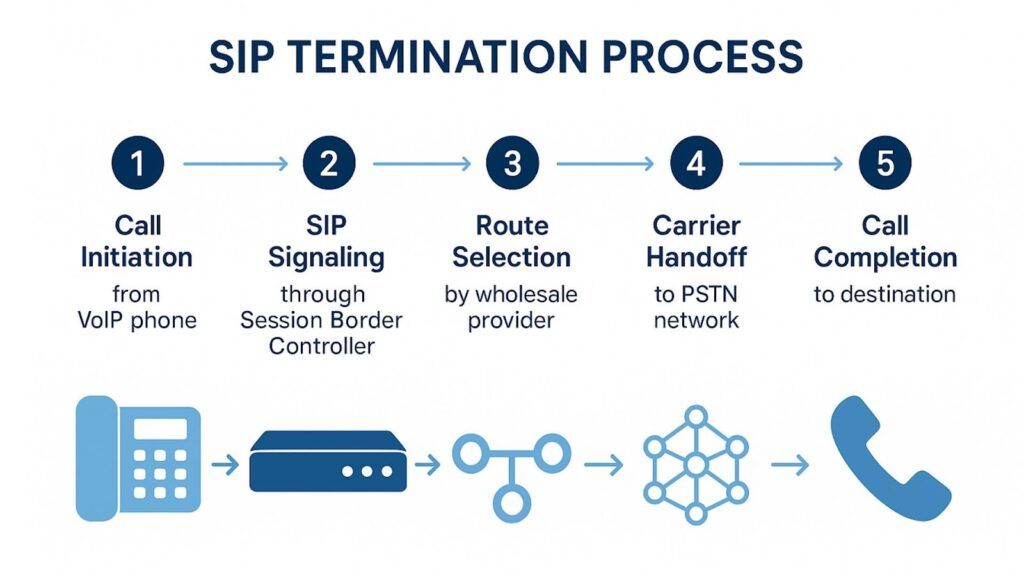
In plain terms: when your VoIP system, PBX, or AI voice agent makes an outbound call to a standard phone number, SIP termination is what happens. Your call travels as IP data packets through your SIP termination provider's network, which then hands it off to the PSTN (Public Switched Telephone Network) to complete the connection to the recipient's phone.
SIP termination is the process of sending phone calls from one provider to another PSTN or VoIP provider. You use SIP trunks to initiate and make outbound calls to customers wherever they are located.
It is distinct from SIP origination, which handles inbound calls arriving at your system from external callers. SIP origination and SIP termination are often offered by the same provider as a combined SIP trunking service, but they are technically separate functions with different infrastructure requirements and pricing.

How SIP Termination Actually Works
Understanding the technical flow matters when evaluating providers, because the quality of each step in this chain determines your call quality.
When a call is placed from your system:
Your IP PBX or application generates a SIP INVITE message containing session description data (codec preferences, media parameters, destination). This travels to your SIP termination provider's infrastructure via TLS-encrypted signaling. The provider routes the call across its carrier network, choosing the optimal path based on cost, quality, and geographic routing rules. At the edge of the public telephone network, a Session Border Controller (SBC) and an IP-PSTN gateway translate the SIP/RTP packets into the signaling format used by the destination carrier. The call is delivered to the recipient's phone through the traditional telephone network.
Border elements such as Session Border Controllers in the network manage the traffic flow between the internal VoIP network and the external PSTN or other networks, ensuring proper call routing and termination. When terminating a call to the PSTN, intermediary technologies like an IP-PSTN bridge assist in translating SIP messages into the appropriate signaling protocols used by the public network.
The quality of this end-to-end chain, the routing decisions, the SBC configuration, the gateway relationships with destination carriers, and the path redundancy built into the network, is what you are actually buying when you choose a SIP termination provider.
SIP Termination vs SIP Origination: Key Differences
SIP Termination | SIP Origination | |
Direction | Outbound (your system to PSTN) | Inbound (PSTN to your system) |
Use case | Outbound calls, AI dialing, contact center | Receiving customer calls, DID numbers |
Pricing model | Per-minute, destination-based | Per DID + per-minute inbound |
Key metric | Call completion rate, latency | Number availability, failover |
Fraud risk | High (toll fraud, IRSF) | Lower (spam, caller ID spoofing) |
Most businesses need both. A complete SIP trunking solution from a single provider typically includes termination (outbound) and origination (inbound) on the same infrastructure, which simplifies routing, support, and billing.
The SIP Termination Market in 2026
This is not a small or stagnant market. The SIP trunking market grows from $73.14 billion in 2025 to $85.07 billion in 2026, projected to reach $181.58 billion by 2031 at a 16.38% CAGR.
The growth is being driven by three converging forces: enterprise migration from legacy PRI lines to cloud-based voice infrastructure, the explosion of AI voice agents that require PSTN access to call real phone numbers, and the BYOC (Bring Your Own Carrier) model that lets businesses connect their own SIP trunks to platforms like Microsoft Teams and Zoom Phone.
AI is entering call routing and monitoring. IDC reports that 35% of enterprises implemented AI-enhanced voice analytics in 2024, with another 28% planning adoption by 2026.
The implication for anyone evaluating SIP termination providers today: your selection needs to account for not just current call volume, but the AI voice workloads that will be running through this infrastructure within the next 12 to 24 months.
SIP Termination Process
What to Evaluate in a SIP Termination Provider
1. Call Completion Rate and Voice Quality
Every provider claims excellent call quality. The test is what happens under real network conditions: packet loss, jitter, peak traffic loads, and international routing to less well-connected destinations.
Key metrics to ask providers for directly: Answer Seizure Ratio (ASR), which measures the percentage of call attempts that successfully connect. A strong provider delivers 85% or higher on domestic routes. Network Call Duration (NCD), which reflects average call duration, a proxy for connection stability. Post-Dial Delay (PDD), the time between dialing and ringback, which directly affects user experience and AI agent call flow.
2. Global Coverage and Local Termination
Coverage maps are often overstated. Providers vary widely in where they can originate and terminate calls. Enterprises with offices across EMEA or APAC should cross-check claimed reach against published rate sheets or customer reviews.
The distinction between direct termination and transit termination matters significantly for call quality. Direct termination means your provider has carrier relationships in the destination country and terminates through a local carrier. Transit termination means your call is handed off to a third-party carrier, adding a hop and introducing quality variance. For high-volume markets, ask explicitly whether termination is direct or transit.
3. Security and Compliance
Modern SIP trunks must guard against call fraud, eavesdropping, and data leaks. Leading providers support TLS for Transport Layer Security and SRTP for Secure Real-Time Transport Protocol for encryption. Compliance with frameworks such as HIPAA for healthcare and GDPR for EU operations should be a non-negotiable requirement. According to the Communications Fraud Control Association, telecom fraud caused $39.9 billion in global losses in 2021.
Beyond encryption, evaluate the provider's fraud detection capabilities. Toll fraud and International Revenue Share Fraud (IRSF) are the primary attack vectors. Providers with real-time anomaly detection, configurable rate limits, and automatic blocking of suspicious call patterns significantly reduce your exposure. STIR/SHAKEN compliance is non-negotiable for any US outbound calling, particularly relevant for contact centers and AI agents making outbound calls.
4. Pricing Structure and True Cost
SIP trunking costs break down into four main areas: channel fees (concurrent call capacity), per-minute rates (outbound and inbound), DID costs ($1-3 per number per month), and setup or activation fees.
The pricing model matters as much as the rate. Two structures dominate the market:
Pricing Model | How It Works | Best For |
Per-minute | Charged per minute of call time | Variable or unpredictable call volume |
Per-channel | Flat monthly rate per concurrent call capacity | Predictable, high-volume operations |
Unlimited bundles | Fixed monthly rate for domestic calls | High-volume domestic calling |
Hybrid | Per-channel base + per-minute international | Mixed domestic/international traffic |
For US domestic calling, termination rates for SIP start anywhere from $0.005 to $0.02 per minute based on routing and provider. International rates via SIP are significantly lower than PSTN, with countries like Canada, Mexico, and Western Europe typically at $0.01 to $0.05 per minute.
Watch for hidden costs: E911 compliance fees, STIR/SHAKEN attestation charges, number porting fees, and early termination penalties on contract plans.
5. Redundancy and Failover Architecture
A SIP termination provider's uptime guarantee is only meaningful if the underlying architecture supports it. Single points of failure in carrier networks are the primary cause of outages that SLA documents do not adequately compensate for.
Evaluate: geographic distribution of Points of Presence (PoPs), multi-carrier route diversity (multiple upstream carriers, not single-carrier dependency), automatic failover logic (how quickly does the system reroute around a failure, and does it require manual intervention), and whether failover testing is possible in a non-production context.
Providers should be evaluated on infrastructure-backed SLAs, carrier-grade availability of 99.99% or higher, and built-in redundancy to handle outages without service disruption.
6. API Access and Programmability
For development teams building communication products, the programmability layer is as important as the voice quality. SIP trunking is now the backbone for PBX deployments, BYOC for UCaaS and CCaaS, and the fastest path to production-grade PSTN access for AI agents.
Evaluate REST API coverage for provisioning (can you spin up new trunks programmatically?), real-time call analytics APIs, webhook support for call events, and compatibility documentation for common platforms like Asterisk, FreeSWITCH, 3CX, and Kamailio.
Provider Landscape: Key Players in 2026
Provider | Best For | Model | Coverage |
Twilio | Developer-first, programmable voice | Pay-as-you-go | 100+ countries |
Telnyx | API-driven, private network | Per-minute / per-channel | Global |
Bandwidth | Carrier-grade US voice | Enterprise contracts | US-focused |
Vonage / Vonage API | UCaaS integration | Hybrid | 50+ countries |
RTC LEAGUE | WebRTC + SIP integration, AI agent infra | Custom / managed | Regional + global |
RTC LEAGUE's SIP trunking is specifically built to serve teams running AI voice agents and WebRTC infrastructure. The integration between WebRTC-native applications and SIP/PSTN termination is where most providers create friction. RTC LEAGUE eliminates that friction by operating both sides of the stack natively.

SIP Termination for AI Voice Agents: What Changes
The entry of AI voice agents into production telephony stacks has changed what SIP termination needs to deliver. Traditional call center SIP trunks were optimized for human agents making relatively low volumes of calls with human-paced call setup. AI agents introduce different demands entirely.
Calls-per-second (CPS) capacity matters more. An AI dialer can initiate calls significantly faster than a human team. Your SIP termination provider needs to support high CPS rates without throttling or quality degradation.
Latency has a lower tolerance. A human caller tolerates a 300ms round-trip delay. An AI voice agent handling real-time conversation needs the media path kept consistently low-latency or the interaction breaks down. Evaluate providers on actual measured latency, not headline numbers.
Telnyx positions its SIP trunking as running on a private network with APIs and global scale. Extra relevance for AI calling: ElevenLabs has documentation that walks through connecting Telnyx telephony components in the ElevenLabs agent workflow, reinforcing Telnyx as a common building block for AI PSTN calling deployments.
TelEcho, RTC LEAGUE's AI voice agent platform, runs on SIP termination infrastructure designed for exactly this workload: high-frequency outbound calling, sub-200ms media latency, and carrier-grade reliability that does not degrade under concurrent load.


-(1).jpg)
.jpg)