.png&w=96&q=75)
If you're building or evaluating a voice AI product, at some point someone is going to ask: why not just use WebSockets? They're simpler, developers already know them, and they can stream data in real time too.
It's a fair question. But for voice AI specifically, the answer matters a lot, and the difference between the two isn't small once real users are involved.
In Short
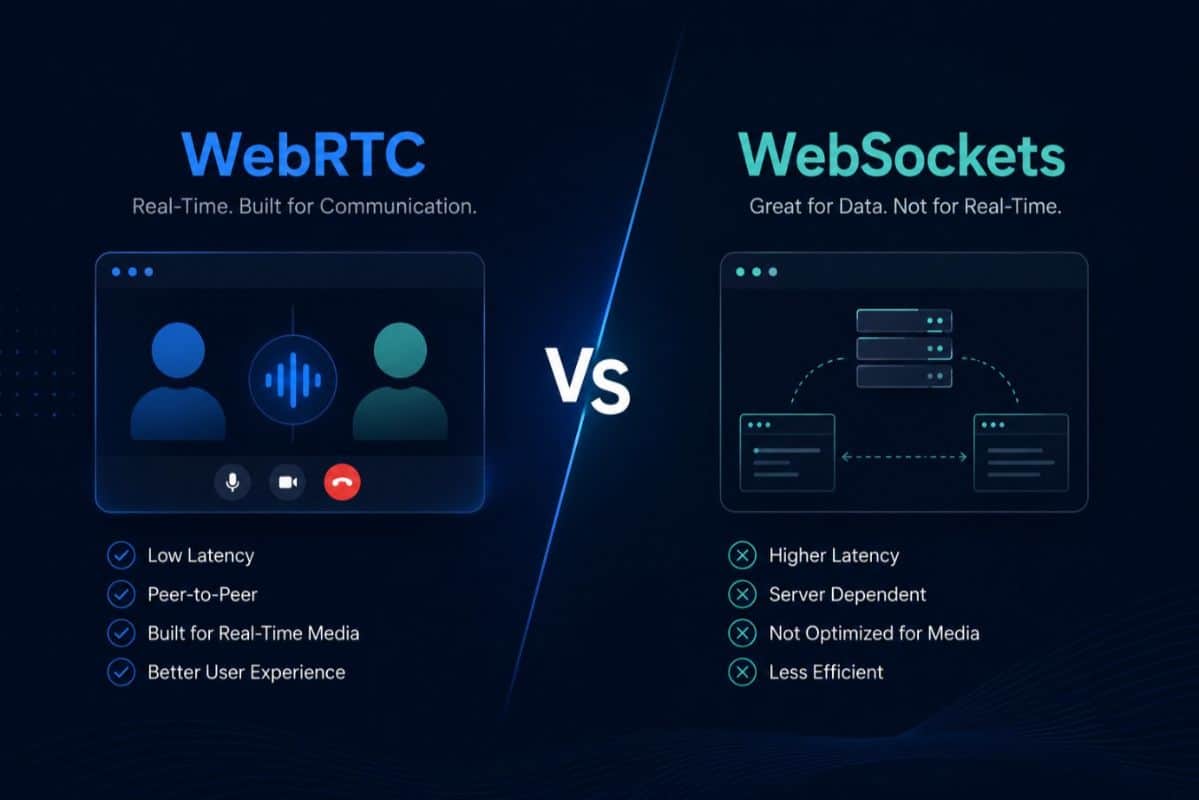
WebSockets are great for sending data quickly. WebRTC is built specifically for real-time audio and video. For voice AI, where every millisecond of delay and every bit of audio quality affects how natural a conversation feels, that difference is the whole story.
What WebSockets Actually Are
A WebSocket is a connection that lets data flow back and forth between a browser and a server continuously, without having to repeatedly ask "do you have anything new for me?" This is why WebSockets are popular for things like live chat, notifications, and stock price updates.
They're fast, widely supported, and easy for developers to implement. The problem is that WebSockets were not designed specifically for audio. They can carry audio data, but they don't come with the tools built specifically to handle real-time voice well.

What WebRTC Actually Is
WebRTC was built from the ground up for one purpose: real-time audio and video communication directly between devices, with minimal delay. It's the technology behind Google Meet, Zoom's browser version, and most modern voice and video calling features.
Where WebSockets are a general-purpose data pipe, WebRTC comes with built-in tools specifically designed for voice and video.
Side-by-Side Comparison
Factor | WebSockets | WebRTC |
Built for audio/video | No | Yes |
Typical latency | Higher | Lower |
Handles packet loss | Manual handling needed | Built-in |
Echo cancellation | Not included | Built-in |
Noise suppression | Not included | Built-in |
Adaptive audio quality | Manual implementation | Built-in |
Peer-to-peer support | No | Yes |
Best suited for | Chat, notifications, data updates | Voice, video, real-time AI agents |
Why This Matters for Voice AI Specifically
1. Latency Adds Up Fast
In a voice AI conversational platform, audio has to travel from the user's microphone to the AI system, get processed, and come back as a spoken response. Every step adds delay.
WebSockets typically introduce more delay in this chain because they weren't designed to optimize for audio specifically. WebRTC is built to minimize this delay at the protocol level, which is exactly what voice AI needs to feel like a real conversation instead of a walkie-talkie exchange.
2. Audio Quality Tools Are Already Built In
WebRTC comes with echo cancellation, noise suppression, and automatic gain control out of the box. These aren't small features. They're the difference between an AI voice agent that sounds clear on a noisy mobile connection and one that sounds like it's underwater.
With WebSockets, all of this would need to be built separately, which adds development time and almost never matches the quality of WebRTC's built-in handling.
3. WebRTC Handles Bad Networks Better
Real users don't have perfect internet connections. WebRTC automatically adjusts to network conditions, reducing audio quality slightly on a weak connection rather than letting the call drop entirely.
WebSockets don't have this built in. A weak connection can mean choppy audio, dropped data, or a frozen conversation, all of which are especially noticeable and frustrating in a voice AI interaction.
4. Built-In Handling for Real Conversations
Voice conversations involve interruptions, pauses, and people talking over each other. WebRTC's audio pipeline is designed with these realities in mind. WebSockets simply move data and leave all of this complexity to the developer.
When WebSockets Still Make Sense
This isn't a "WebSockets are bad" situation. They're excellent for what they're designed for.
Use Case | Better Fit |
Live chat messages | WebSockets |
Sending AI text responses alongside voice | WebSockets |
Real-time notifications | WebSockets |
Voice or video conversations | WebRTC |
AI voice agents | WebRTC |
In fact, a lot of real-world voice AI systems use both. WebRTC carries the actual voice conversation, while WebSockets might handle secondary data, like sending transcripts to a dashboard in real time.

What This Means for Businesses Building Voice AI
If you're building or buying a voice AI product, the underlying communication protocol isn't just a technical detail. It directly affects:
How natural the conversation feels
How well the system handles real-world network conditions
Whether background noise and interruptions get handled gracefully
How the system performs at scale with many simultaneous calls
A voice AI built on WebRTC starts with a significant head start on all of these, simply because the technology was designed for exactly this purpose.
At RTC LEAGUE, this is the foundation behind the voice AI infrastructure used in products like TelEcho, built on WebRTC specifically because real conversations need real-time technology, not a workaround.
The Bottom Line
WebSockets and WebRTC can both move data quickly, but only one of them was built specifically for real-time voice. For AI voice agents, that's not a minor technical preference. It's the difference between a conversation that feels natural and one that constantly reminds the user they're talking to a machine over a delayed connection.
.png&w=2048&q=75)

-(1).jpg)
.jpg)