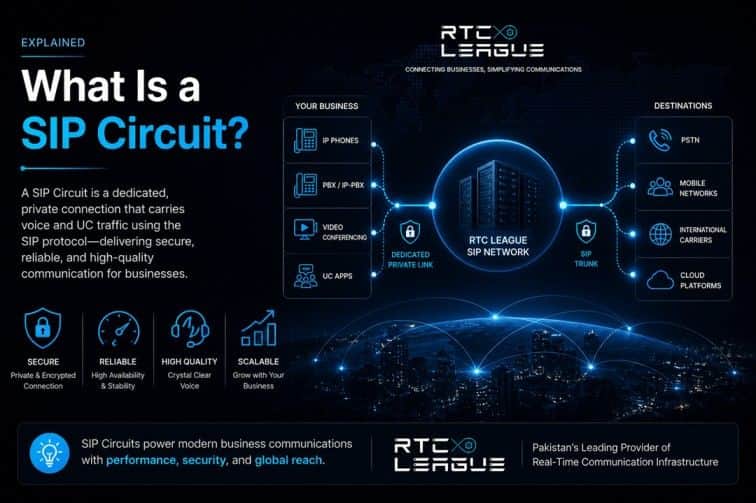

Every phone call your business makes travels across a circuit. For most modern businesses, that circuit is not a physical copper wire. It is a SIP circuit: a software-defined, IP-based communication channel that carries voice, video, and messaging data across your existing internet connection.
Understanding what a SIP circuit is and how it works is not optional for businesses that depend on reliable voice communication. It is the foundation of every call center, enterprise telephony system, and AI voice agent deployment operating today.
What Is SIP?
SIP stands for Session Initiation Protocol. It is the signaling protocol responsible for initiating, managing, and terminating real-time communication sessions over IP networks.
When a call is made, SIP handles the setup: it finds the recipient, establishes the connection parameters, negotiates media format, and signals the session start. When the call ends, SIP signals termination and releases the resources.
SIP is protocol only. It does not carry the actual voice audio. That job belongs to RTP (Real-time Transport Protocol), which transmits the media stream once SIP has set up the session.
Together, SIP and RTP form the two-layer backbone of modern voice over IP communications.
What Is a SIP Circuit?
A SIP circuit is the complete, end-to-end communication path established through the SIP protocol. It includes:
The signaling path managed by SIP
The media path managed by RTP
The SIP trunk connecting your phone system to the public telephone network (PSTN)
The SIP endpoints: phones, softphones, PBX systems, or AI voice agents
A SIP circuit is active for the duration of a call. It is established on demand, released when the call ends, and does not consume fixed physical resources like a traditional telephone circuit.
This is the fundamental advantage of SIP over legacy PSTN circuits. Traditional telephone infrastructure required a dedicated physical line for every concurrent call. A SIP circuit is virtual. You provision concurrent channels, not physical lines.

What Is a SIP Trunk?
A SIP trunk is the virtual connection between your on-premise PBX or hosted phone system and a SIP provider's network. It is the pipe through which SIP circuits flow.
One SIP trunk can carry multiple simultaneous calls. The number of concurrent calls a trunk supports depends on the channel capacity you purchase from your SIP provider and the available bandwidth on your internet connection.
The term "trunk" comes from traditional telephony, where a trunk line was a high-capacity connection between switching centers. In SIP, the trunk is logical, not physical.
How SIP Trunking Works
SIP trunking is the service model through which businesses connect their internal phone systems to the public telephone network using SIP protocol over the internet, replacing traditional ISDN or analog phone lines.
The flow of a call through a SIP trunk works as follows:
A user initiates a call from a SIP endpoint (desk phone, softphone, or AI agent).
The PBX or hosted UCaaS platform routes the call to the SIP trunk.
The SIP trunk carries the signaling request to the SIP provider's network.
The SIP provider routes the call to the destination, which may be on the PSTN, another SIP network, or a mobile carrier.
The media stream (voice audio) flows directly between endpoints via RTP.
When the call ends, SIP signals termination and the circuit is released.
The SIP trunk is the critical chokepoint in this chain. Its quality determines call clarity, connection reliability, latency, and failover behavior.
Why SIP Trunking Replaced Traditional Phone Lines
The commercial case for SIP trunking over legacy PSTN connections is straightforward.
Cost: SIP trunking eliminates the need for physical phone lines. Businesses pay for concurrent channels, not per-line hardware. International call rates through SIP providers are significantly lower than through traditional carriers.
Scalability: Adding call capacity with traditional ISDN required ordering physical lines with lead times measured in weeks. Adding SIP channels is a configuration change, completed in hours.
Flexibility: SIP trunks work with any geographic number. Businesses can present local numbers in multiple countries without physical infrastructure in those locations.
Redundancy: Quality SIP providers offer automatic failover routing. If one carrier route fails, calls reroute through an alternative path without interruption.
AI integration: SIP is the protocol layer through which AI voice agents connect to real telephone numbers. Every AI voice deployment serving inbound or outbound calls over PSTN runs on SIP trunking infrastructure.
What to Look for in the Best SIP Providers
Not all SIP trunking services are equivalent. The differences between providers show up under load, during failures, and in geographic reach. Evaluating the best SIP services requires looking beyond the price-per-minute metric.
Network redundancy: The best SIP providers operate across multiple carriers and Points of Presence (PoPs). If one route degrades, traffic shifts automatically. Single-carrier SIP providers expose you to carrier-level outages.
Latency and call quality: SIP circuits carrying voice are sensitive to latency and jitter. Providers with geographically distributed infrastructure deliver lower round-trip times, which translates directly to call clarity. Target sub-150ms one-way latency for voice.
SIP trunk capacity: Evaluate concurrent channel limits against your peak call volume. Providers that throttle or cap concurrent calls without warning will create call drops during traffic spikes.
Codec support: Quality SIP services support G.711, G.729, and opus codecs at minimum. AI voice agent deployments often require wide-band audio codecs for natural-sounding synthesis.
E.164 number support: Your SIP provider should support full E.164 number formatting and CLI (Caller Line Identification) presentation for outbound calls. This matters for AI voice agents where caller ID authenticity directly affects answer rates.
SIP security: TLS for signaling encryption and SRTP for media encryption are non-negotiable in enterprise SIP deployments. Providers that do not enforce TLS/SRTP are a liability.
Support for AI voice agents: Not all SIP providers are prepared for AI workloads. AI voice agents generate call patterns that differ from human callers: rapid session initiation, high concurrency, and precise timing requirements. Confirm your provider has experience with AI-driven SIP traffic.

SIP Trunking for AI Voice Infrastructure
The intersection of SIP trunking and AI voice agents is where the technology becomes strategically significant.
AI voice agents, including outbound calling bots and inbound IVR systems, connect to real telephone numbers through SIP trunks. The SIP circuit is the mechanism through which an AI agent's synthesized voice reaches a human on a regular phone.
For AI voice deployments to work at scale, the SIP infrastructure must support:
High concurrent session initiation rates without rate limiting
Low jitter for natural-sounding AI voice delivery
DTMF pass-through for IVR interaction
Call recording and monitoring for quality assurance
Programmable routing for intelligent call distribution
RTC LEAGUE building AI voice products on inadequate SIP infrastructure discover the failure mode when it is already affecting customers.


-(1).jpg)
.jpg)