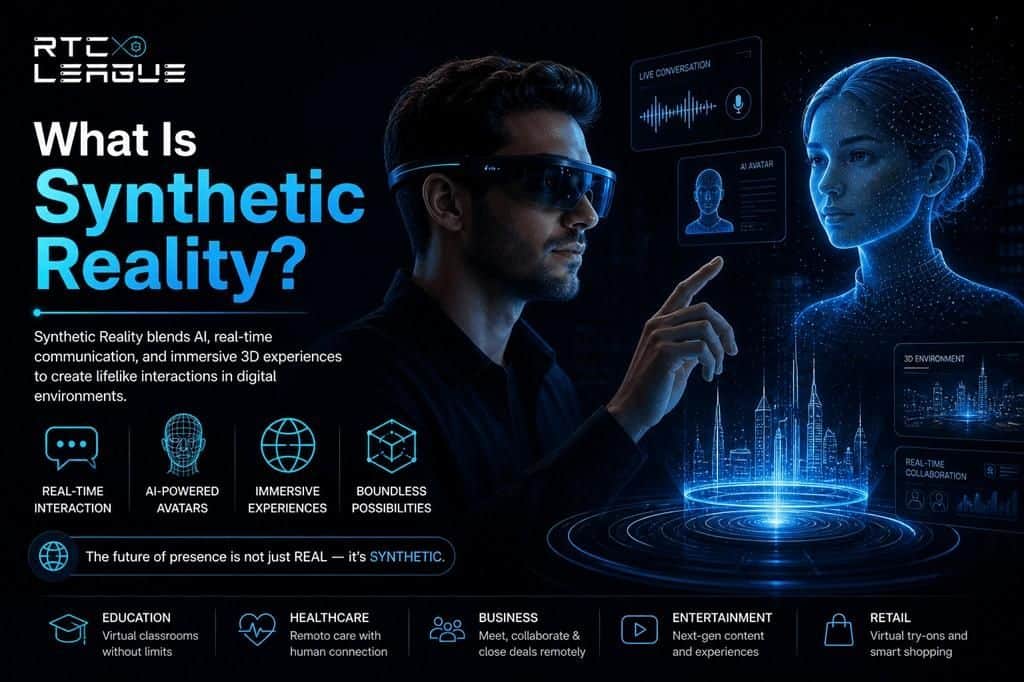

The boundary between the physical and the digital is collapsing. Synthetic reality is the technological convergence that makes this collapse possible. It refers to a constructed layer of experience that feels real but is generated, mediated, or augmented by AI systems, spatial computing, and digital rendering engines.
It is not virtual reality in the traditional sense. It is not just augmented reality either. Synthetic reality is the next stage: fully convincing, AI-driven environments and representations of people and objects that behave, respond, and exist with near human fidelity.
Understanding what synthetic reality is requires understanding what it replaces. Static screens. Two-dimensional video calls. Pre-recorded content. Synthetic reality replaces all of that with dynamic, context-aware digital experiences.
How Synthetic Reality Works
Synthetic reality is not a single technology. It is a stack of interconnected systems that work together to produce an experience indistinguishable from physical reality.
The core components include:
Generative AI produces visual and audio content in real time. It can render a human face, generate speech, adapt lighting and spatial positioning, and respond dynamically to input within milliseconds.
AI avatars are digital representations of humans or synthetic personas. They move, speak, and respond based on AI models trained on real human behavior. An AI avatar can hold a conversation, express emotion, gesture appropriately, and maintain consistent identity across sessions.
Spatial computing maps digital content into three-dimensional physical space. Devices like spatial headsets or depth cameras allow AI-generated elements to coexist with real-world surroundings.
AI holograms take this further. A synthetic reality hologram projects a photorealistic, three-dimensional image of a person or object into physical space without requiring the user to wear a headset. Early implementations already exist in live entertainment, telemedicine, and enterprise training.
Together, these systems create environments and interactions that are indistinguishable from physical presence.

Synthetic Reality vs. Virtual Reality vs. Augmented Reality
These terms are often confused because they overlap. The distinctions matter.
Virtual reality (VR) replaces the physical environment entirely. The user enters a digital world.
Augmented reality (AR) overlays digital content on the physical world. The user still sees the real environment with digital additions.
Synthetic reality is broader than both. It uses AI to construct or manipulate reality itself. This includes generating synthetic humans, synthesizing voices, constructing environments, and creating experiences where the origin point of "real" becomes ambiguous.
The defining characteristic of synthetic reality is AI-driven generation. Content is not pre-made. It is produced on demand, adapting to context, user behavior, and real-world inputs in real time.
AI Avatars: The Human Face of Synthetic Reality
AI avatars are among the most commercially significant expressions of synthetic reality today. Businesses are deploying AI avatars across customer service, sales, education, and enterprise communication.
What makes a modern AI avatar different from a simple chatbot or digital character is behavioral realism. A well-built AI avatar:
Maintains consistent identity and personality across sessions
Responds to conversational context, not just individual inputs
Mirrors natural human cadence, pause, and inflection in speech
Adapts expression and tone based on sentiment analysis
Operates at scale across thousands of simultaneous interactions
For enterprise use, AI avatars eliminate the need for human agents in routine, high-volume interactions without sacrificing the quality of experience. In sales and marketing, they allow brands to maintain a human face at digital scale.
AI Holograms: Synthetic Reality Enters Physical Space
The synthetic reality hologram is the most dramatic frontier of this technology. Unlike screen-based AI avatars, AI holograms place a synthetic human or object into the same physical room as the viewer.
Current AI hologram technology is being used in:
Live events and entertainment where performers appear on stage remotely or posthumously as photorealistic projections.
Enterprise collaboration where executives and teams in different locations share a physical meeting space through holographic presence.
Retail and hospitality where AI hologram assistants greet customers and guide them through physical environments.
Medical training where surgical procedures are projected as interactive, three-dimensional AI simulations.
The distinction that makes an AI hologram different from a simple projection is intelligence. The hologram is not playing back recorded content. It is responding, adapting, and interacting in real time, driven by the same generative AI systems powering conversational agents.
Why Synthetic Reality Matters Right Now
The commercial and operational implications of synthetic reality are significant and immediate.
For communication infrastructure, synthetic reality demands ultra-low latency networks. A synthetic reality hologram that stutters or lags is not a hologram. It is a broken experience. This is why the real-time communication layer underneath synthetic reality experiences must be engineered to WebRTC grade standards, with sub-200ms end-to-end latency.
For business operations, AI avatars are already delivering measurable cost reduction. Organizations deploying AI avatars in customer-facing roles report significant reductions in operational cost while maintaining high satisfaction rates.
For brand and marketing, synthetic reality enables a new category of presence. Brands can exist in physical and digital environments simultaneously, represented by AI avatars and holograms that maintain brand voice, appearance, and behavior at any scale.

The Infrastructure Behind Synthetic Reality
Synthetic reality is only as good as the infrastructure running it. The visual and conversational layers are visible. The communication layer is invisible but equally important.
Real-time data transport, media processing, and low-latency rendering depend on:
WebRTC-based media delivery for real-time audio and video
Edge computing to minimize processing delay
High-throughput SIP infrastructure for voice layer integration
AI inference at the edge for response generation under 300ms
RTC LEAGUE building synthetic reality products need partners who understand this infrastructure layer, not just the visual layer. The experience lives in the rendering. The reliability lives in the network.


-(1).jpg)
.jpg)