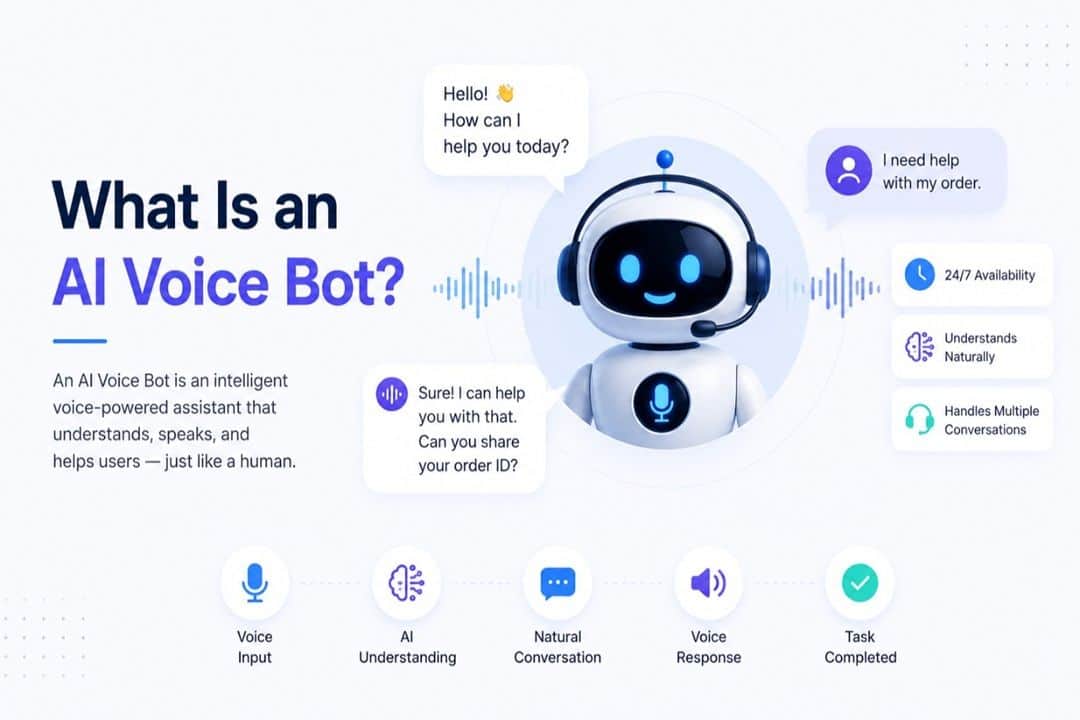

AI chatbot development services build and deploy conversational AI systems across four core architectures: rule-based, NLP, generative, and hybrid. Rule-based bots handle structured, compliance-critical flows. NLP bots interpret free-text queries within a trained domain. Generative bots powered by large language models handle open-ended conversation. Hybrid systems combine rule-based reliability with generative flexibility. Most enterprise deployments in 2026 require hybrid architecture because no single model handles both regulated transactions and unpredictable customer queries equally well.
The Four Architectures of AI Chatbot Development
AI chatbot development services in 2026 fall into four architectural categories, each solving a different problem. Selecting the wrong architecture for a use case produces a chatbot that functions technically but fails operationally. The category selection decision happens before any technology evaluation and should be driven by conversation structure, compliance requirements, and the volume of unpredictable queries the system will face.
Most businesses approaching AI chatbot development have already encountered the core problem: "chatbot" describes both a simple FAQ widget and a fully autonomous AI agent handling complex support workflows. The gap between them is not just technical complexity. It is architectural category.
Here is the landscape as it stands in 2026:
Architecture | How It Processes Input | Best Suited For | Primary Risk |
Rule-based | Fixed decision trees, button inputs | Structured queries, compliance-critical flows | Cannot handle free-text input gracefully |
NLP | Intent recognition within trained domains | Defined knowledge base with varied phrasing | Fails outside trained intent scope |
Generative AI | LLM reasoning, open-ended conversation | Broad, unpredictable customer queries | Hallucination risk, compliance exposure |
Hybrid | Rules for sensitive flows, LLM for open queries | Most enterprise and mid-market deployments | Higher initial build complexity |
The majority of mature enterprise deployments operate as hybrid systems. Businesses need generative AI's conversational range for exploratory queries and rule-based AI's deterministic behavior for financial transactions, account modifications, and regulated interactions.
When to Choose Each Architecture
Architecture selection maps directly to the nature of the queries the chatbot will handle. High-structure, low-variability queries suit rule-based or NLP systems. Low-structure, high-variability queries require generative AI. Regulated transactions require rule-based determinism regardless of how sophisticated the surrounding AI is. This selection should be made at project scoping, not after development begins.

Rule-Based Chatbots
Choose when:
Queries are highly structured with predictable inputs (order tracking, balance checks, store hours)
Regulatory or compliance requirements demand absolute consistency in responses
Deployment timeline is short (weeks, not months)
The failure mode of an incorrect response has direct legal or financial consequences
Avoid when:
Customers ask questions in their own words without knowing the expected input format
The query scope is broad enough that no decision tree can cover it adequately
Volume of query types grows faster than you can update the decision tree
Realistic performance benchmark: Rule-based bots resolve 60% to 80% of queries in tightly scoped use cases. Resolution rate drops sharply outside the scripted scope.
NLP Chatbots
Choose when:
You have a defined knowledge base but customers phrase queries in multiple ways
Intent-based routing across 10 to 50 query categories is the primary requirement
You need measurable improvement over a rule-based system without full generative AI
Avoid when:
Customer queries regularly go outside the trained intent categories
The business needs multi-turn clarification conversations (NLP bots lose context quickly)
The query domain changes frequently (retraining cycles are resource-intensive)
Realistic performance benchmark: NLP bots achieve 75% to 90% intent recognition accuracy within trained domains, dropping to 30% to 50% outside them.
Generative AI Chatbots
Choose when:
Customer queries are broad and structurally unpredictable
Multi-turn conversations with contextual memory are required
The business can implement and maintain adequate guardrails and evaluation frameworks
The use case is not directly regulated (or you have legal review of guardrail design)
Avoid when:
The use case involves account-specific actions, financial transactions, or clinical information
You cannot dedicate engineering resources to ongoing evaluation and guardrail maintenance
Data used to ground the LLM contains confidential or personally identifiable information that requires separate handling
Realistic performance benchmark: Generative bots achieve 40% to 70% containment rates in open-domain deployment without fine-tuning. Fine-tuned models with curated knowledge bases achieve 65% to 85% containment.
Hybrid Chatbots
Choose when:
Sensitive transactions (payments, account changes) and casual queries coexist in the same channel
You need generative flexibility for exploration and rule-based safety for execution
You operate across multiple regions with different compliance requirements
You want the AI to handle complexity but cannot accept unpredictable behavior on critical paths
Realistic performance benchmark: Hybrid systems consistently achieve 70% to 85% resolution rates in enterprise contact center contexts. Escalation to human agents is reduced by 25% to 40% compared to rule-based systems alone.
RTC LEAGUE builds hybrid systems as the default architecture for mid-market and enterprise clients. The configuration routes critical flows through deterministic logic while routing exploratory conversation to the LLM with domain-specific grounding.
Channel Selection: Where Your Chatbot Lives Determines Integration Complexity
Channel selection is often treated as a secondary decision after architecture is chosen. This is incorrect. The channels a chatbot must serve determine the integration architecture, the conversation state management approach, and the compliance surface. Omnichannel chatbot development from day one is significantly less expensive than bolting channels onto a single-channel deployment after launch. Context fragmentation is the primary failure mode of channel-first deployments.
Channel | Primary Use Case | Integration Complexity | RTC LEAGUE Notes |
Website chat widget | B2B, high-consideration purchases | Low | Suitable for all four architectures |
WhatsApp Business API | Retail, services, Pakistan and MENA markets | Medium | TelEcho WhatsApp AI integration recommended |
In-app chatbot | SaaS, mobile-first products | Medium | Requires SDK or API integration |
Voice + chat unified agent | Multi-channel customer service | High | WebRTC-based unified agent architecture |
Slack / Microsoft Teams | Internal employee assistant | Low to Medium | LLM-powered productivity assistant |
SMS | Transactional notifications, reminders | Low | Rule-based preferred for compliance |
The strongest chatbot development services design for all required channels before writing a line of code. Unifying conversation context across channels requires a shared state management layer that must be built into the architecture. Retrofitting it after single-channel deployment typically costs 60% to 80% of the original development budget.
For Pakistan and MENA market deployments, WhatsApp Business API is not an optional channel add-on. It is the primary customer communication surface. RTC LEAGUE's TelEcho platform integrates WhatsApp AI agents natively alongside voice calling, eliminating the context fragmentation that occurs when voice and messaging run on separate systems.
Industry Fit: Architecture by Vertical
Chatbot architecture requirements vary by industry based on regulatory environment, query structure, channel distribution, and the business consequences of incorrect responses. The following use cases represent common deployment patterns across industries served by enterprise AI chatbot development services, with realistic performance outcomes from production deployments.

E-Commerce
Problem: High-volume, repetitive queries (order status, returns, product questions) consume support capacity and delay resolution for complex issues.
Solution: Hybrid chatbot integrating with order management, catalog, and returns systems. Generative layer handles product discovery and recommendations. Rule-based layer handles order modification, returns initiation, and payment queries.
Outcome: 70% to 80% tier-1 query containment rate, reduction in average handle time for escalated queries (human agents receive pre-populated context), measurable conversion lift on product recommendation flows.
Banking and Financial Services
Problem: Customers ask general questions (loan rates, branch hours, product comparisons) and account-specific questions (balance, transaction history, payment disputes) in the same session. Generative AI handling account-specific actions creates compliance and fraud risk.
Solution: Hybrid architecture with hard routing rules. Generative AI for general financial information and product explanation. Rule-based deterministic flows for any account-specific action. Strict content guardrails preventing the generative layer from referencing specific account data.
Outcome: Compliant handling of regulated interactions with human-equivalent resolution rates for general queries. Zero generative AI exposure on account-specific flows.
Healthcare
Problem: Appointment booking, symptom triage, medication reminders, and administrative queries arrive in the same channel. Clinical information requires accuracy that general LLMs cannot reliably provide.
Solution: NLP or hybrid bot with tightly scoped knowledge base for clinical information. Rule-based flows for appointment actions and prescription reminders. Generative AI restricted to administrative queries only. Mandatory escalation for any clinical question outside the trained domain.
Outcome: Appointment no-show rate reduction of 15% to 30% through automated reminder and confirmation flows. Reduced call center load for routine administrative queries.
SaaS and Technology
Problem: Customers need onboarding guidance, feature explanations, documentation search, and account support in a single interface. Support teams spend a disproportionate share of time on questions that documentation already answers.
Solution: Generative AI chatbot grounded in product documentation with RAG (Retrieval-Augmented Generation) architecture. NLP intent routing for account-specific actions. Human handoff for billing disputes, contract questions, and technical issues requiring access to production environments.
Outcome: 50% to 70% reduction in tier-1 support volume. Measurable improvement in time-to-first-value for new customers using AI-guided onboarding.
Real Estate
Problem: Lead qualification from property inquiries requires multi-turn conversation to capture budget, timeline, location preference, and purchase intent. Human agents handling this at scale consume resources that should be focused on closing.
Solution: Hybrid chatbot handling initial lead qualification and property matching. Generative layer conducts multi-turn qualification conversations and recommends properties from the live catalog. Rule-based layer books viewings and routes qualified leads to human agents with a pre-populated qualification summary.
Outcome: 3x to 5x increase in qualified leads passed to sales, with 40% reduction in time agents spend on initial qualification.
Competitive Reference: How Platform Providers Compare
The AI chatbot development services market includes major cloud platforms (Microsoft, Google, IBM), communication platforms (Twilio, Intercom), and specialized AI companies. Each has meaningful strengths and limitations. Honest evaluation requires acknowledging where alternatives outperform as well as where they fall short.
Provider | Strength | Limitation | Best Fit |
Microsoft Azure Bot Service | Enterprise integration, Teams, Copilot ecosystem | High technical complexity, developer-heavy | Large enterprises already in the Microsoft ecosystem |
Google Dialogflow | Intent recognition accuracy, Google Cloud integration | Complex pricing, limited out-of-the-box deployment | Enterprises with strong GCP footprint |
IBM Watson Assistant | Strong in regulated industries (finance, healthcare) | High cost, slower deployment compared to newer platforms | Finance and healthcare enterprises with IBM relationships |
Twilio Flex + AI | Programmable, channel-agnostic, strong telephony | Requires significant custom development, no out-of-the-box AI | Developer-led teams building custom communication workflows |
Intercom / Drift | Fast deployment, strong B2B sales use case | Limited generative AI depth, expensive at scale | SaaS companies needing fast deployment for sales and support |
RTC LEAGUE | WebRTC-native voice + chat, WhatsApp AI, South Asia / MENA regional deployment | Earlier-stage international brand recognition vs. US-based platforms | Businesses needing voice + chat unification, WhatsApp AI, or regional deployment in Pakistan and MENA |
Twilio remains the better choice for programmable communication APIs at the infrastructure layer. Microsoft Azure Bot Service provides stronger enterprise compliance tooling for organizations already in the Microsoft ecosystem. RTC LEAGUE's differentiation is in voice-native chatbot architecture and South Asia / MENA regional deployment where WhatsApp is the primary customer channel.
What Separates a Strong Chatbot Development Provider
Most AI chatbot deployments that underperform do so because of poor knowledge base curation, inadequate conversation design, or missing integration depth, not because of the underlying model. Provider evaluation should weight operational expertise as heavily as technical capability. A development team that ships a technically correct system without a strong conversation design practice and an analytics layer will produce a chatbot that degrades over time rather than improving.
Discovery-first approach. Providers that begin with conversation mapping before technology selection produce better outcomes. Customer journeys must be understood before architecture is chosen.
Knowledge base curation expertise. This is where most chatbot deployments fail. LLMs trained on poor-quality or incomplete source content produce poor-quality responses regardless of model capability. Ask any provider how they structure and evaluate knowledge base content before deployment.
Conversation design as a core practice. Tone, persona, fallback handling, and escalation logic are not engineering decisions. They are conversation design decisions that have direct impact on resolution rate and caller satisfaction.
Integration depth, not just integration count. A chatbot connected to your CRM surface reads customer data. A chatbot integrated with your CRM write layer actually updates records, creates tickets, and triggers workflows. These are fundamentally different and the difference should be verified in vendor demos.
Analytics and continuous improvement. Chatbot performance degrades without ongoing tuning. Intent coverage gaps, emerging query patterns, and model drift all require active monitoring. Providers who treat deployment as a one-time project rather than a continuous product will ship something that works at launch and quietly underperforms within 90 days.

The RTC Chatbot Selection Framework
Use this framework to determine the right architecture and provider category for your specific deployment:
RTC Chatbot Selection Framework v1.0
Step 1: Define the primary outcome.
Reduce inbound support volume: Go to Step 2
Increase sales conversion: Go to Step 2
Automate internal processes: Skip to hybrid/generative with clear scope
Step 2: Map conversation structure.
Under 20 predictable query types with structured inputs: Rule-based
20 to 100 query types with variable phrasing: NLP
Open-ended, multi-turn, unpredictable: Generative or hybrid
Mix of structured transactions and open queries: Hybrid (recommended)
Step 3: Identify compliance requirements.
Financial transactions on the same channel: Require rule-based routing for those flows regardless of overall architecture
Clinical information: Require scoped knowledge base and mandatory escalation
No regulated content: Full generative AI evaluation is appropriate
Step 4: Map required channels.
Voice + chat: Unified agent architecture required from day one
WhatsApp as a primary channel: WhatsApp Business API integration required at architecture stage
Single channel only: Start there, design for expansion
Step 5: Evaluate provider against your answers from Steps 1 to 4. Select providers who address your specific architecture requirement, not the most feature-rich platform in the market.
Decision Tree
Common Deployment Mistakes
Five patterns that consistently produce underperforming chatbot deployments:
Launching without a tested escalation path to a human agent. Callers who cannot reach a human when the AI fails lose trust in the entire brand.
Letting generative AI respond to regulated topics without guardrails. Brand safety and legal exposure require tested refusal patterns.
Skipping the analytics layer. A chatbot without conversation analytics cannot be improved. It can only be replaced.
Using a generic persona that conflicts with brand voice. The chatbot's tone is a brand touchpoint. Misalignment damages brand consistency.
Going live without an evaluation suite covering edge cases and adversarial inputs. Every chatbot encounters unexpected input. The response to unexpected input should be deliberate, not random.


-(1).jpg)
.jpg)