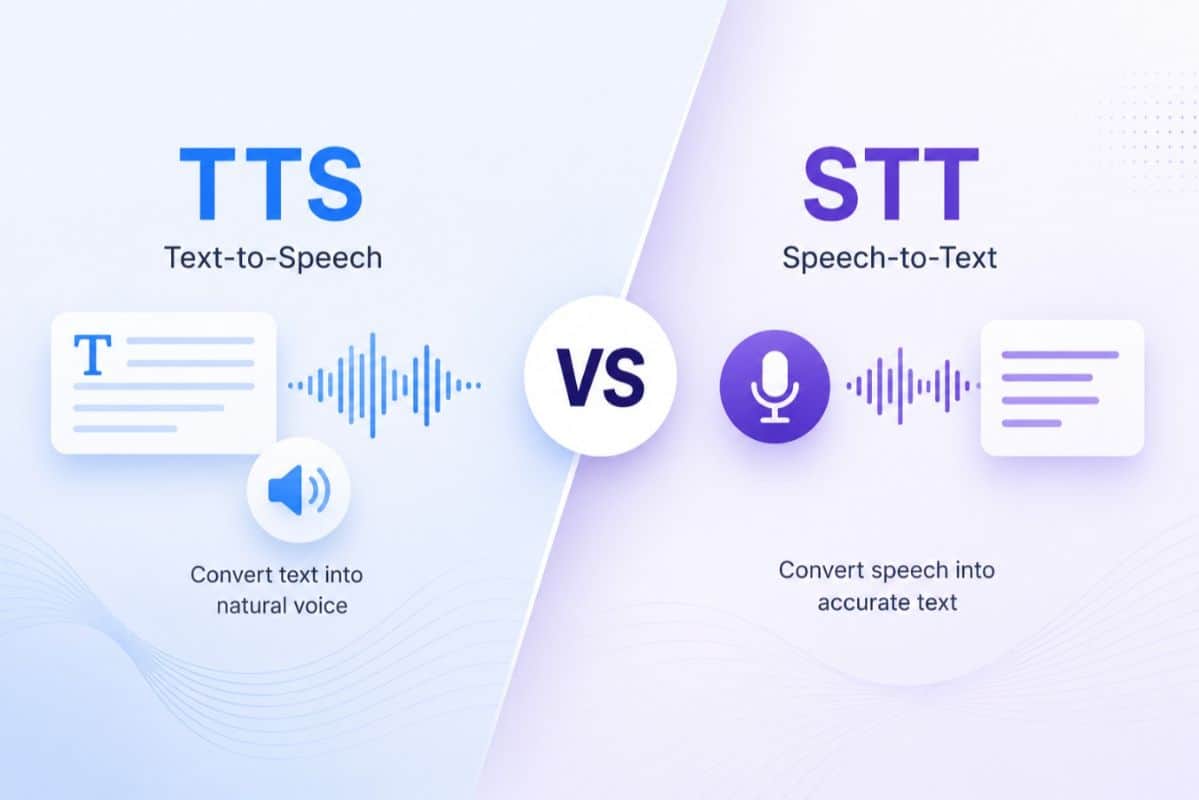

What Problem Each Technology Solves
TTS and STT are distinct technologies that address opposite directions of a voice conversation. TTS enables an AI system to speak. STT enables an AI system to listen and understand. Conflating them or treating them as a single component leads to misconfigured voice AI deployments where the wrong layer receives optimization priority, producing poor production results despite high investment.
Most teams evaluating voice AI platforms encounter TTS and STT as a pair and assume they are two sides of the same system. They are not. They are independent components with separate quality metrics, separate failure modes, and separate optimization paths.
Getting this distinction correct at the design stage determines whether a voice AI deployment performs at the quality level needed for production use or delivers a substandard caller experience despite significant infrastructure investment.
What Is TTS (Text-to-Speech)?
TTS is the technology that converts written text into spoken audio output. In customer outreach, TTS is what the caller hears. It is the AI system's voice. TTS quality is evaluated on naturalness (prosody), pronunciation accuracy, and voice character. Poor TTS produces robotic speech that increases call abandonment. High-quality TTS produces near-human speech that maintains caller engagement through the full interaction.
When an AI voice agent says "Your appointment is confirmed for Thursday at 2pm. Would you like a reminder the morning before?" the caller heard the output of a TTS engine. The sentence existed as text, was passed to the TTS engine, and converted into the audio waveform the caller received.

Where TTS Is Deployed
Use Case | TTS Role | STT Requirement |
Outbound appointment reminders | Primary output layer | Minimal (digit input only) |
Payment alert calls | Primary output layer | Minimal |
IVR menu prompts | All audio the caller hears | Digit recognition only |
Outbound lead qualification | Response generation | High (full NLU required) |
Inbound AI agent responses | Every AI-generated reply | High |
Voicemail delivery | Full message | None |
How TTS Quality Is Measured: Mean Opinion Score
The standard benchmark for TTS quality is the Mean Opinion Score (MOS), defined by the ITU-T P.800 recommendation. Human listeners rate synthesized speech on a scale of 1 to 5 across naturalness, clarity, and listening effort.
MOS Score | Quality Description | Caller Perception |
1.0 to 2.0 | Unacceptable | Callers disconnect or complain |
2.0 to 3.0 | Poor | Significant friction, high abandon rate |
3.0 to 3.5 | Fair | Noticeable as robotic, usable |
3.5 to 4.0 | Good | Acceptable for most business use |
4.0 to 4.5 | Excellent | Near-human, minimal caller friction |
4.5 to 5.0 | Ideal | Indistinguishable from human speech |
Production voice AI for customer outreach should target MOS 4.0 or above. Below 3.5, caller abandonment rates increase measurably and brand perception is negatively affected.
The Three TTS Quality Factors That Drive Business Outcomes
Prosody. Prosody is the rhythm, stress, and intonation of synthesized speech. Natural human speech pauses at commas, stresses key words, and varies pitch throughout a sentence. TTS engines with weak prosody produce flat, continuous audio that sounds like the system is reading, not speaking. For outbound notifications delivered as complete sentences, poor prosody is the difference between a caller who feels informed and one who disconnects mid-message.
Voice character and regional fit. A TTS voice that does not match the caller demographic reduces engagement. A Pakistani caller receiving a South Asian English voice achieves significantly higher engagement than the same caller receiving an American-accented voice. Gender, age register, and regional accent are configurable on enterprise TTS platforms and should be matched to the primary caller demographic, not left at default.
Pronunciation accuracy for brand and product terms. General-purpose TTS engines are trained on standard vocabulary. Brand names, product names, industry terms, and regional proper nouns are frequently mispronounced. TelEcho supports custom pronunciation dictionaries that define the exact phonetic rendering of any term used in outbound scripts. This is not optional for any deployment where the AI will speak the company or product name.
What Is STT (Speech-to-Text)?
STT, also called Automatic Speech Recognition (ASR), converts spoken audio into text that the AI system can process. In customer outreach, STT is what determines whether the AI understands what the caller said. STT accuracy at the transcription layer determines the accuracy of intent detection, routing, and resolution downstream. A 5% word error rate, when concentrated on semantically critical words, can make an entire call flow fail.
When a caller says "I need to cancel, not reschedule," the audio is captured by the STT engine and converted to a text string. That text string is then passed to the NLU layer for intent detection. If the STT engine transcribes this as "I need to cancel, but reschedule," the NLU receives different input and may classify the intent as schedule modification rather than cancellation. The error originates at the STT layer and produces a failed resolution.
Where STT Is Deployed
Use Case | STT Role | Required Accuracy |
Inbound support routing | Determines intent, routes call | Under 5% WER |
COD order confirmation | Captures yes/no and details | Under 3% WER |
Lead qualification | Interprets prospect responses | Under 5% WER |
Payment collection calls | Captures payment intent and details | Under 2% WER |
Post-call CSAT surveys | Captures satisfaction rating | Under 4% WER |
Voice command interfaces | Single-command recognition | Under 3% WER |
How STT Quality Is Measured: Word Error Rate
Word Error Rate (WER) is the industry standard metric for STT accuracy. It measures the percentage of words incorrectly transcribed relative to the total words spoken, calculated as:
WER = (Substitutions + Deletions + Insertions) / Total Reference Words × 100
A 5% WER sounds minor. In a 100-word caller statement, 5 words are wrong. If those words include action verbs ("cancel" vs "handle"), temporal references ("today" vs "Tuesday"), or critical details (account numbers, amounts), the consequences are direct: wrong routing, failed resolution, and escalation to a human agent.
WER Level | Practical Impact on Voice AI |
Under 2% | Reliable for financial and payment use cases |
2% to 5% | Acceptable for standard support and qualification |
5% to 10% | Noticeable routing errors, increased escalation rate |
Above 10% | System produces consistently wrong intent detection |
Real-World Audio Is Not Benchmark Audio
STT vendors publish WER figures measured in clean studio conditions: single speaker, no background noise, standard microphone, controlled bitrate. This is not the audio your callers produce.
Real callers call from:
Moving vehicles (road noise, compressed mobile audio)
Offices (background conversation, keyboard sounds)
Homes (television, family noise)
Shopping environments (crowd noise, echo)
Testing STT accuracy must be done under your actual caller audio conditions, not benchmark conditions. A system with a published 3% WER in studio conditions may perform at 9% to 12% WER on compressed mobile network audio from a noisy environment. TelEcho's STT configuration for South Asia and Middle East markets is tested against actual mobile audio from each deployment region.
How TTS and STT Work Together in a Voice AI Pipeline
TTS and STT are the output and input layers of a voice AI pipeline. They do not interact directly. They interact through the shared system that connects them: NLU for understanding, dialogue management for conversation flow, and the LLM for response generation. Optimizing either layer in isolation while neglecting the other produces a system that either understands well but responds poorly (poor TTS) or responds well but understands poorly (poor STT).
The Full Voice AI Pipeline
Each stage is a separate component with its own latency contribution and failure mode. The total end-to-end latency the caller experiences is the sum of all stage processing times.
Latency Budget Across the Pipeline
Pipeline Stage | Target Latency | Failure Mode When Exceeded |
STT (streaming) | Under 80ms | Delayed intent processing, cascading lag |
NLU processing | Under 50ms | Routing delay |
LLM inference (first token) | Under 200ms | Long pause before AI speaks |
TTS (first chunk) | Under 120ms | Gap after generation before audio |
Audio transport (WebRTC) | Under 30ms | Additional transmission delay |
Total end-to-end | Under 480ms | Unnatural conversation cadence |
WebRTC-based infrastructure eliminates transport-layer overhead and keeps audio delivery under 30ms per direction. REST API audio pipelines over HTTPS/TCP add 80ms to 200ms in transport alone, consuming a significant portion of the latency budget before any AI processing begins.

The RTC Channel Selection Framework
Use this framework to determine which component requires priority investment for your specific deployment:
RTC Channel Selection Framework v1.0
Step 1: Identify the primary call direction.
Outbound only (notifications, reminders, alerts): Go to Step 2A
Inbound only (customer-initiated support, queries): Go to Step 2B
Both directions (full conversational AI agent): Go to Step 2C
Step 2A: Outbound-only deployment
STT requirement is minimal (often digit recognition only)
Invest in TTS quality: voice character, prosody, pronunciation dictionaries
Target MOS 4.0 or above on the voice used for delivery
Test pronunciation of all brand and product terms before deployment
Step 2B: Inbound-only deployment
TTS matters for responses, but STT is the priority investment
Test STT accuracy specifically against your caller base audio conditions
Target WER below 5% under real mobile audio from your primary markets
Test for accent coverage, background noise, and fast speech
Step 2C: Full conversational AI agent
Both layers must perform at production quality
Streaming STT required (batch STT adds 300ms to 600ms per turn)
Streaming LLM inference required (first-token delivery under 200ms)
Chunk-based TTS required (first audio chunk under 120ms)
Total end-to-end latency target: under 500ms
Enterprise Use Cases by Industry
TTS and STT requirements vary by industry based on the regulatory environment, caller demographics, and the consequences of transcription errors. Healthcare and financial services demand the lowest WER targets because errors in clinical terms or financial details carry direct operational risk. E-commerce and retail can tolerate slightly higher WER thresholds where errors in product names are recoverable.
Healthcare
Use case: Appointment confirmation and medication reminders via outbound AI calling.
TTS priority: High. Clinical terms must be pronounced correctly. A patient hearing a mispronounced medication name will not trust the interaction.
STT priority: Medium for outbound confirmation (yes/no detection). High for inbound appointment modification calls.
WER target: Under 3% for any call capturing clinical information.
Financial Services
Use case: Payment reminders, account alerts, and early-stage collections.
TTS priority: High. Tone and pacing in collection calls affects whether the caller engages or disconnects.
STT priority: High for payment confirmation and dispute capture. Any STT error capturing a payment amount or account detail is a compliance risk.
WER target: Under 2% for financial detail capture.
E-Commerce
Use case: COD order confirmation, delivery scheduling, and post-purchase CSAT.
TTS priority: High for COD confirmation calls. The caller must clearly hear the order summary.
STT priority: Medium. Most responses are yes/no confirmation. Digit recognition for delivery address confirmation.
WER target: Under 4% for standard confirmation. Under 2% for address capture.

Real Estate
Use case: Lead qualification calls for property inquiries.
TTS priority: High. The AI's voice quality directly affects whether the prospect treats the interaction as credible.
STT priority: High. Property-specific terminology, budget ranges, and timeline information must be captured accurately for CRM qualification.
WER target: Under 5% for qualification context. Under 3% for financial detail capture.
BPO and Contact Centers
Use case: Tier 1 inbound support with human escalation for complex issues.
TTS priority: High for response delivery. Caller satisfaction with AI responses affects escalation rate.
STT priority: Very high. The accuracy of first-turn intent detection determines whether the caller reaches resolution or escalation. A single STT error on the initial query reroutes the entire call.
WER target: Under 4% across full range of support query types.
Decision Tree: Which Technology to Prioritize
What is the primary call direction?
Why Platform Infrastructure Determines TTS and STT Ceiling
TTS and STT quality is bounded by the infrastructure running them. Even best-in-class STT and TTS models perform below their capability when the surrounding pipeline introduces latency that forces them into non-streaming mode or delivers degraded audio input from a poor transport layer. WebRTC infrastructure preserves audio signal quality at the point of capture, which directly improves STT transcription accuracy before the model receives the audio.
A voice AI platform built on WebRTC delivers audio to the STT layer with less compression artifact and lower jitter than a platform routing audio through legacy SIP/PSTN infrastructure or REST API audio capture. This matters because STT models are trained on relatively clean audio. Compression artifacts and jitter introduce patterns the model was not trained to handle, which increases WER.
TelEcho's infrastructure uses WebRTC audio capture and delivery across all deployment regions, ensuring the audio that reaches the STT layer and the audio that reaches the caller from TTS are both delivered at the highest achievable quality within the network conditions of each market.
Competitive Reference: Where Different Platforms Prioritize
Vendors in the AI voice platform category differ in where they optimize TTS and STT investment:
Platform Type | TTS Strength | STT Strength | Latency Approach |
Developer-focused platforms | Configurable | Configurable | Developer-managed |
Template-based platforms | Pre-set voices | Pre-set models | Default config |
Infrastructure-first platforms (TelEcho) | Regional voices, custom pronunciation | Streaming, regional accent coverage | WebRTC-native |
Infrastructure-first platforms consistently outperform template-based platforms on TTS quality in non-English markets because they configure voice character to regional caller demographics rather than using global default voices.
External References
ITU-T P.800 Recommendation: Methods for Subjective Determination of Transmission Quality (defines MOS scoring methodology)
NIST Speech Group: Standard WER calculation methodology
Max Planck Institute for Psycholinguistics: Research on human inter-speaker gap timing in natural conversation (200ms to 350ms baseline)

Conclusion and Recommendation
TTS and STT are foundational to every voice AI deployment. The mistake most teams make is treating them as a single category and optimizing the wrong one for their actual use case.
If your primary use case is outbound notification: Invest in TTS quality. Match voice character to your caller demographic. Configure custom pronunciation dictionaries. Target MOS 4.0 or above. STT requirements for digit confirmation are minimal.
If your primary use case is inbound support: Invest in STT accuracy. Test against real caller audio from your actual markets. Target WER under 5% in production conditions. Poor STT accuracy cannot be compensated for by better TTS.
If your use case requires full conversational AI: Both layers must operate in streaming mode. Budget for the latency cost of each stage and ensure total end-to-end latency stays under 500ms. Infrastructure selection matters as much as model quality.
TelEcho's deployment configuration addresses all three scenarios through configurable STT model selection, regional voice options for TTS, custom pronunciation dictionary support, and WebRTC-based audio delivery that preserves signal quality from call initiation to termination.


-(1).jpg)
.jpg)