
Modern business communication is evolving rapidly
Traditional phone lines are being replaced by internet-based systems that connect teams and customers worldwide. At the core of this evolution is SIP trunking, the technology powering many cloud-based voice systems.
This guide explains what SIP trunking is, how it works, and why businesses are switching to it in 2025.
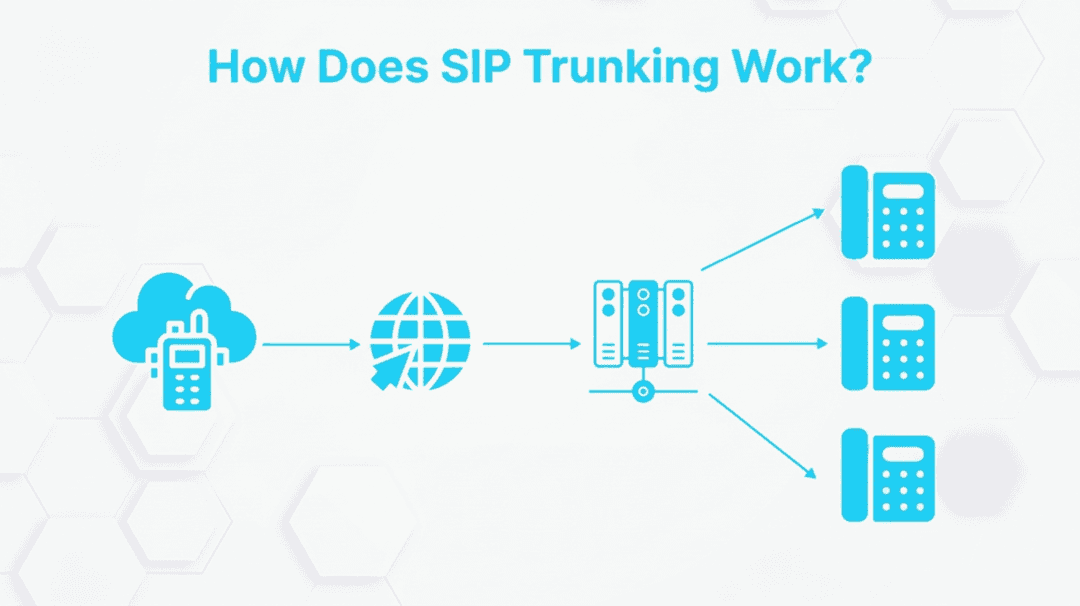
How Does SIP Trunking Work?
Session Initiation — When you place a call, SIP establishes a connection between your system and the provider’s network.
Data Transmission — Your voice is converted into digital packets and transmitted over the internet using VoIP protocols.
Session Termination — Once the call ends, SIP closes the session and releases bandwidth for other communications.
Because SIP uses standard internet infrastructure, it eliminates the need for dedicated copper lines, reducing costs and simplifying network management.

SIP Trunking vs. VoIP: Understanding the Difference
VoIP (Voice over Internet Protocol): The general method of making calls over the internet.
SIP (Session Initiation Protocol): The specific protocol that manages and routes those calls.
Every SIP call is a VoIP call, but not every VoIP call uses SIP. SIP provides greater control, reliability, and compatibility than generic VoIP solutions.
Core Benefits of SIP Trunking for Businesses
Cost Efficiency — Reduce telephony spend by up to 60% by replacing legacy trunks.
Scalability on Demand — Add/remove channels instantly for seasonal or high-volume needs.
Business Continuity — Automatic failover and rerouting keep calls live during outages.
Global Presence — Local numbers and international routing via Tier-1 carriers.
Integrations — Connect to CRMs, collaboration tools, AI assistants, and analytics.
Industry Use-Cases
Contact Centers — Thousands of concurrent calls with intelligent routing.
Healthcare — Secure, compliant private SIP trunks.
E‑Commerce — Connect online customers with agents worldwide.
Startups — Start with a free SIP line and scale up.
Enterprises — International SIP providers for consistent global quality.
Cloud SIP Trunking and Hosted SIP Providers
Cloud adoption has moved voice communication into virtual environments. With cloud SIP trunking, your voice channels live entirely in the cloud — no physical PBX required. Hosted SIP providers manage infrastructure, routing, and redundancy while you control configurations and analytics.
Private SIP Trunking for Security‑Sensitive Organizations
Finance, healthcare, and government sectors often prefer private SIP trunks for dedicated, encrypted, and compliant connectivity. RTC League helps design hybrid architectures that blend private security with cloud scalability.

Key Considerations When Selecting Providers
99.99% uptime and multi‑region redundancy
Global coverage with local DIDs and low‑latency routes
TLS/SRTP encryption and compliance
Flexible pricing (per‑channel or usage‑based)
Strong support and PBX/CRM compatibility
The Future of SIP Trunking
AI‑powered predictive routing
Real‑time translation
5G edge integrations for ultra‑low latency
Why Choose RTC League
Custom deployments
Global partnerships
Innovation driven
End‑to‑end support
Upgrade your communication stack today, start with a free SIP line trial or request a personalized SIP trunk consultation.


-(1).jpg)
.jpg)